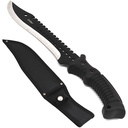
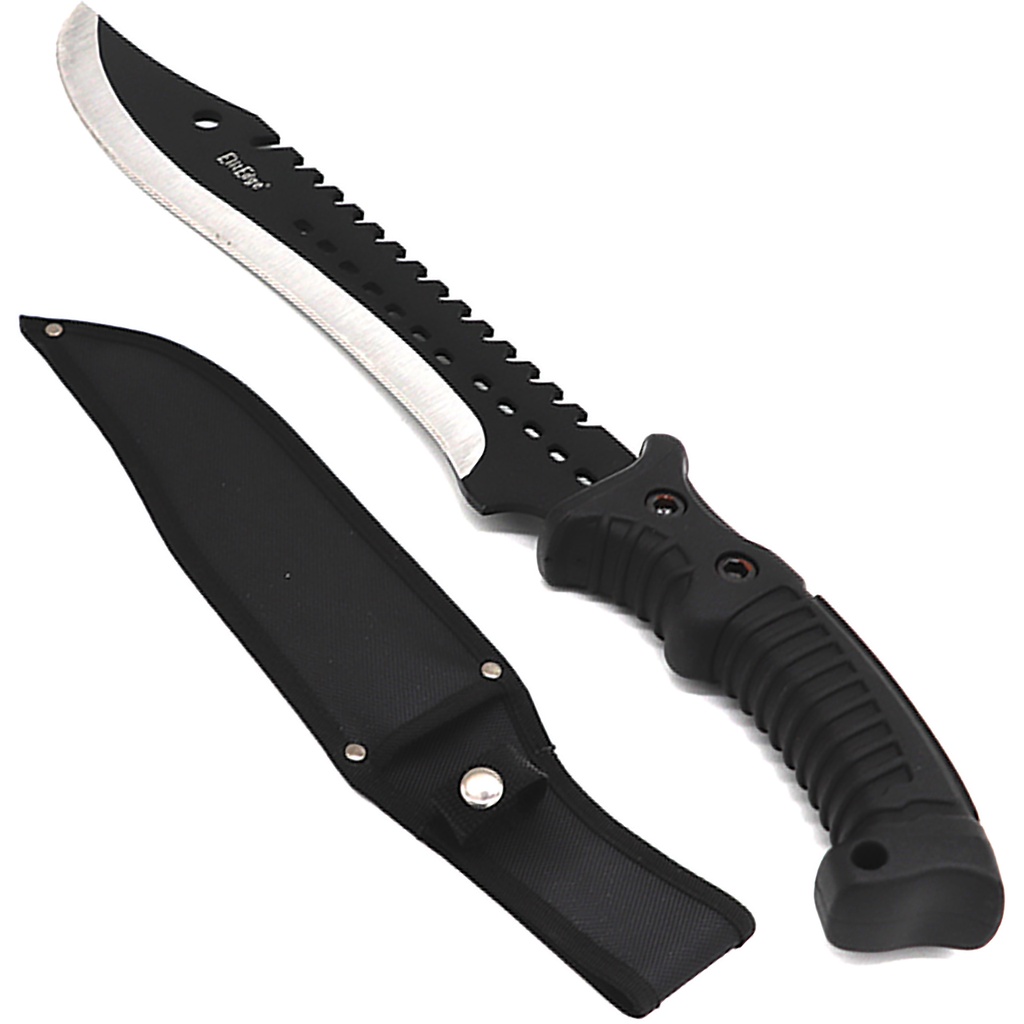
Blackout Sawback Field-Ready Fixed Blade Knife - Matte Black
15 sold in last 24 hours
Out past the last gate, this fixed blade earns its ride. The matte black clip point punches clean holes, while the partial serrations chew through rope and old webbing. Sawback spine bites into limbs for quick notches and camp fixes. Full-tang steel under a rubber grip keeps your hand locked in. Belt sheath keeps it handy in the truck, on a pack, or at the lease. This is the knife that quietly goes to work when the sun drops and the chores don’t.
Blackout Sawback Fixed Blade Built for Long Days Outside Town
Dust on the caliche road, fence line running crooked, and a half-roll of barbed wire still waiting in the bed. This is where a matte black fixed blade like this earns its keep. Full-tang steel from tip to pommel, a sawback spine waiting on sapling limbs, and a rubber handle that doesn't twist when your hands are slick with sweat or rain. It’s a field knife that looks like purpose and cuts like it too.
Why This Field-Ready Tactical Fixed Blade Belongs on a Texas Belt
On a place where a single day can run from cutting hay twine to prying open feed bags to trimming canvas straps, a pocket knife comes up short. This fixed blade carries on the belt in a low-profile sheath, riding flat under a shirt or along the hip of a pair of work pants. The clip point blade runs long enough to dig into feed sacks, punch clean through plastic drums, or pierce tough hide when you’re putting down a feral hog. Partial serrations near the handle chew through old rope, sun-hardened nylon, and frayed tie-down straps that should’ve been replaced a year ago.
The matte black finish keeps reflection down around headlights, campfires, and in the brush. It doesn’t shine, it doesn’t show off. It just cuts. The sawback spine isn’t for show; it bites into green limbs for quick pot hooks, gear hangers, and gate props when you’re fixing things on the far side of the pasture. For a buyer used to hard edges and harder weather, it feels like a tool built for the way Texas actually works.
Handle, Steel, and Carry Built Around Real Texas Use
The heart of this knife is a full-tang steel blade, running straight through to the flat pommel. You feel that backbone when you twist it in a cut or use the spine for scraping. It’s not a delicate piece; it’s a bar of steel ground into a clip point with a two-tone edge that tells you where the sharp starts and ends. The rubber handle wraps around that tang with deep finger grooves, giving your grip a home whether you’re bare-handed in August heat or wearing cheap work gloves on a cold Panhandle morning.
That handle texture matters when sweat, dust, and oil mix. It stays planted when you’re cutting old hose off a fitting or trimming nylon sling straps under a trailer. The flat pommel carries a lanyard hole for cord—run it through and you’ve got a little insurance working around water gaps, tanks, or boat docks. On the belt, the sheath keeps the blade tight and covered. Nylon with a snap closure, it catches on the hip just right when you’re stepping in and out of a truck, climbing a ladder, or squeezing between panels.
Texas Knife Law Confidence for a Tactical Fixed Blade
Fixed Blade Legality in Modern Texas Carry
In this state, the law draws its main knife line at blade length, not whether it’s a switchblade or automatic. OTF and other automatics have been legal here for years, and fixed blades like this ride under the same general rules. The key is length and location: over 5.5 inches of blade moves a knife into the “location-restricted” category, meaning you keep it clear of places like schools, courts, and certain government buildings. Out on private land, at the lease, in the truck, or on a jobsite that isn’t on a restricted property, a fixed blade like this is simply a tool on your belt.
This isn’t a pocket toy or a novelty automatic; it’s a working knife. For Texas buyers who already understand how the state treats OTF knives, this fixed blade falls right into that same pattern of freedom with a few lines you don’t cross. You pick it up for the ranch, the lease, or the shop, not the courthouse or the football stadium. Carried that way, it stays on the right side of both the law and common sense.
Reading the Blade for Texas Jobs
Look close at the working edge and you see three tools built into one line of steel. The forward clip point gives you control for detail work: cleaning up a hog, opening heavy packaging, or cutting a clean slot for a strap or cable. Drop back a bit and the straight edge slices clean through feed bags, poly line, and tape. Closer to your fingers, the serrations take over, ripping through old rope, webbing, and stubborn material that fights a smooth edge.
Flip the knife over and that sawback spine is ready to drag through green mesquite, willow, or oak saplings to make notches, stakes, and crossbars. Around camp or a stock tank, it’s enough steel to baton kindling or split light pieces of firewood when you don’t want to haul an axe. In short, it’s one blade doing three or four jobs without swapping tools.
Texas OTF Knife Buyers and Why This Fixed Blade Still Belongs in the Truck
A lot of serious knife folks in this state carry an OTF or automatic in the pocket. Fast one-handed deployment, compact size, and modern styling fit right into daily life in town and on the road. But even the best Texas OTF knife hits its limit when you’re prying, batoning, or working hard around steel, dirt, and bone. That’s where a full-tang fixed blade like this earns its seat in the truck door or on the four-wheeler rack.
The Blackout Sawback doesn’t try to replace your OTF knife; it covers the heavy work your automatic shouldn’t see. Think of it as the field cousin to your Texas OTF knife—same respect for sharp steel, different job. The OTF handles quick cuts, everyday chores, and clean environments. This fixed blade takes over when the work turns rough: brush clearing on a creek bottom, camp setup in the Hill Country, or cleaning a hog in a muddy wheat field. Both have a place; this one just expects more dirt.
From Lease Gate to Campfire in One Blade
On a long weekend at the deer lease, this knife never really gets put away. It starts the morning hanging on the belt while you clear dead limbs off the road. It moves to the tailgate, cutting rope and straps as you shift blinds or feeders. When the sun goes down and the fire kicks up, it’s still there, shaving kindling and notching poles for cook setups. That is where a field-ready fixed blade proves its worth to someone used to living with a knife in hand.
Questions Texas Buyers Ask About Tactical Fixed Blades
Are OTF knives legal to carry in Texas?
Yes. Texas removed the old switchblade and automatic restrictions years ago, so OTF knives and other automatics are legal to own and carry. The main concern now is blade length and where you take it. Any knife with a blade over 5.5 inches—including some OTF and fixed blades—can’t go into certain location-restricted places like schools, courts, secure government buildings, and a few other specific spots. Outside those locations, Texas law treats an OTF knife as another legal cutting tool. Same principle applies to this fixed blade: respect the length limits and don’t carry it where the law says not to.
Is this fixed blade practical for ranch and lease work here?
It was built for exactly that kind of life. The full-tang steel gives it enough backbone for cutting, prying, and scraping around metal, lumber, and wire. The sawback spine handles quick notches for posts and camp rigs. Partial serrations push through tough rope and ratchet straps hardened by the sun. The rubber grip keeps your hand where it needs to be when sweat, rain, and dust mix. For a ranch, lease, or farm truck, it’s a simple decision: this is the knife that stays where the work is hardest.
How should I choose between a Texas OTF knife and this fixed blade?
Think in pairs, not either-or. If you spend most of your time in town, at work, or driving between jobs, a Texas OTF knife makes sense in the pocket—quick one-handed use, easy to carry, and fully legal under current state law. When your day shifts to pasture roads, fence lines, or camp, a fixed blade like this belongs on your belt or in the truck. The OTF is for fast, light cuts. This is for the dirty, heavy work you don’t want to hand to a smaller mechanism. Most serious Texas knife folks end up carrying both.
First Use: Where This Knife Finds Its Place in Your Texas Day
Picture a late fall evening, sky turning that flat pale blue over the back pasture. You’ve got one more gate to shore up before dark. The knife rides quiet on your belt until you need it—then the sheath snaps open, matte black steel in your hand. Clip point opens a bag of clips, serrations tear through a worn-out rope, sawback carves a quick notch in a brace pole. By the time you head back to the house, dust on your boots and sweat cooling under your shirt, the blade’s got its first marks in the finish. That’s how you know it belongs. Not in a drawer. On your belt, in your truck, and in the places where a knife is still a tool, not a toy.
| Blade Color | Black |
| Blade Finish | Matte |
| Blade Style | Clip Point |
| Blade Edge | Partial-Serrated |
| Handle Finish | Matte |
| Theme | None |
| Sheath/Holster | Sheath |