Camp Mesa Damascus Skinning Knife - Turquoise Horn
15 sold in last 24 hours
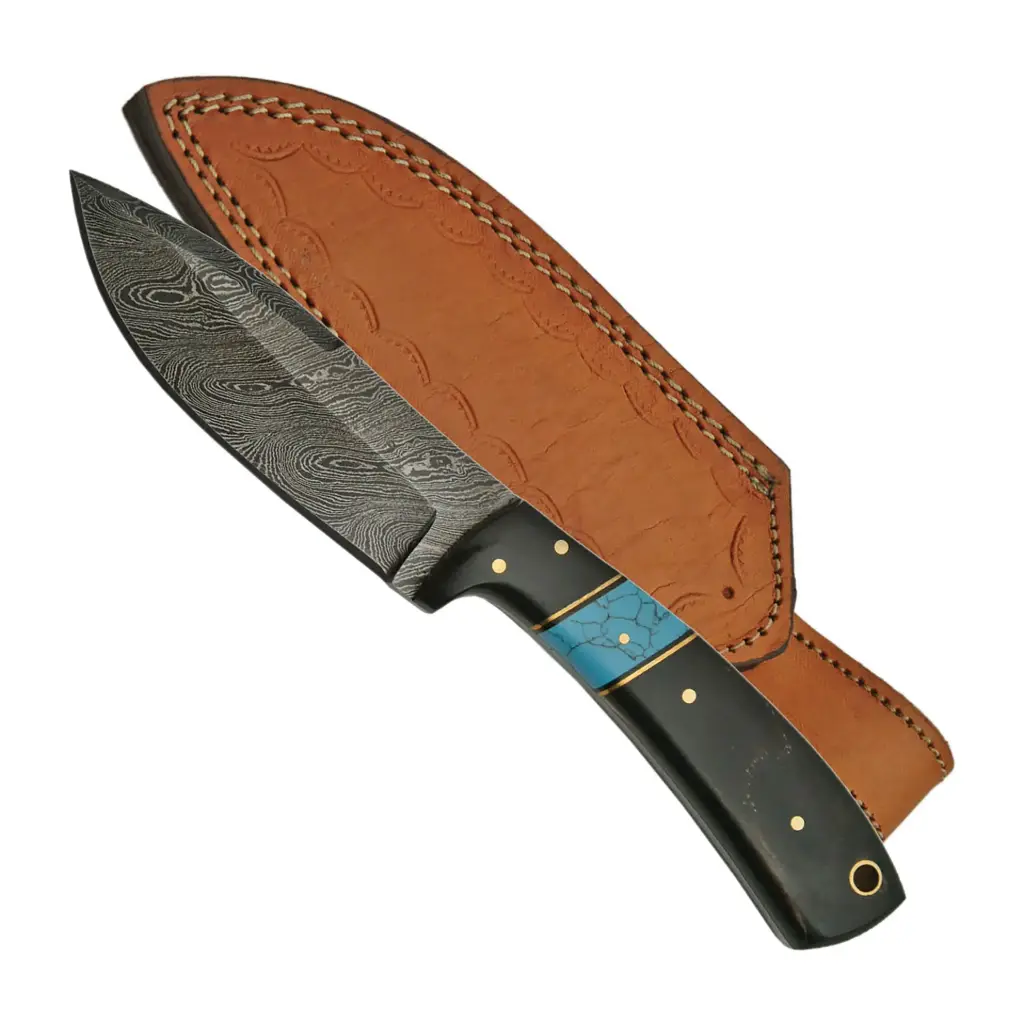
South of San Angelo, after a clean evening shot, this Damascus skinning knife goes to work. An 8-inch full-tang build with a 4-inch drop point edge glides through hide and joint without wandering. The turquoise-and-horn handle locks into a bloody or gloved hand, brass pins staying tight season after season. It rides in a stamped leather sheath on your belt, more tool than trophy, but handsome enough for the mantle when the work’s done.
Camp Mesa Damascus Skinning Knife for Texas Hunts
Out past the last cattle guard, with mesquite running the fence line and a feeder humming in the distance, this Damascus skinning knife earns its keep. Deer down, light fading, you don’t need pretty words. You need an 8-inch full-tang blade that bites clean, tracks straight, and doesn’t twist in your hand when the hide gets tough.
This is a hunter’s knife built for Texas country where you might dress a Hill Country buck one weekend and a Panhandle hog the next. Damascus steel up front, turquoise and horn in your palm, and a leather sheath riding on your belt until it’s time to work.
Why This Damascus Skinning Knife Belongs on a Texas Belt
In a state where a hunt might mean cedar thickets near Kerrville or wheat fields outside Abilene, your skinning knife can’t be delicate. The 4-inch Damascus drop point on this blade is wide enough to control, sharp enough to open up a rib cage without sawing, and balanced so well you can choke up for fine work around the shoulders and neck.
The full-tang construction runs the length of the 8-inch profile, so when you’re pulling through thick hog hide or easing along the backbone of a South Texas buck, the knife doesn’t flex or chatter. The edge geometry is tuned for field dressing: it slips under hide without diving too deep, then powers through joints when you bear down.
On a Texas belt, weight matters. This knife has enough heft to feel anchored, not so much that it drags. The leather sheath sits close to your side, riding well in a pickup seat, on an ATV, or under a jacket while you’re checking feeders at daylight.
Handle Built for Real Texas Field Work
Texas hunts don’t always happen on dry, level ground. Sometimes you’re on a muddy sendero near Laredo, sometimes on frosty rock outcroppings in the Llano. The horn handle on this skinning knife is shaped to lock into your hand in all of it. The curve nests along your fingers, while the swell at the back keeps your grip when your hands are cold, wet, or slick with blood.
Turquoise inlay runs through the handle like a dry creek bed catching evening light—more than decoration, it gives a subtle texture change your fingers can feel as you shift grips. Brass spacers and pins keep everything tight and true, season after season, through rattling rides in a UTV box or years of sitting in a gun safe between seasons.
The lanyard hole at the butt gives you options. Tie in leather thong if you like extra security while quartering a hog out of a high rack, or loop paracord so you can hang it in the skinning shed where it’s always in the same place.
Texas Knife Law, Hunting Culture, and This Fixed Blade
Texas used to have a mess of blade length restrictions and confusion about what could be carried where. Those days are gone. Since state law changes that removed the old switchblade and automatic bans and relaxed blade length rules, a fixed blade hunting knife like this Damascus skinner is straightforward to own and use for most Texans.
On private land, at deer camp, in a skinning shed, or riding in your truck console on the way to your lease, this full-tang fixed blade is right at home. Urban carry is where common sense still rules. While state law allows larger blades and fixed knives in most places, you still have to watch specific prohibited locations like schools, some government buildings, and secured areas. This hunting knife is built for the lease, the ranch, and the back forty—not for walking downtown Austin.
For Texans, the question isn’t just “is it legal,” it’s “is it appropriate here.” This Damascus skinning knife is exactly that in hunting country from the Pineywoods to the Big Bend: a purpose-built tool for game, not everyday street carry.
Designed for Texas Game: From Hill Country Deer to Panhandle Hogs
Not all hunting knives handle Texas animals well. Whitetail, mule deer, exotics, feral hogs—each demands a blade that can shift from delicate to stubborn work without losing its edge halfway through the job. The Damascus steel on this skinning knife carries a layered pattern you can see, and an edge that holds through multiple animals when you’re not abusing it.
The 4-inch blade length hits the sweet spot for Texas game. Short enough to stay precise when you’re caping around antlers in a Hill Country taxidermy shed, long enough to reach through the chest cavity on a big boar in the brush country. That drop point keeps the tip from punching through guts when you’re running a long opening cut up the belly by headlamp.
The leather sheath, with its tooling and tight stitching, isn’t just for show. On a ranch outside Uvalde or a day lease south of Sweetwater, dust and grit work their way into everything. This sheath shields the Damascus from that constant abrasion, so when you draw it at the skinning rack, the edge is ready instead of sanded dull.
Questions Texas Buyers Ask About Damascus Skinning Knives
Are OTF knives legal to carry in Texas?
Texas law changed in recent years to remove the old ban on switchblades and automatics. Today, OTF knives—along with other automatics—are generally legal to own and carry across most of the state, as long as you respect location-based restrictions like schools, certain government buildings, and secure areas. There’s no separate ban on OTFs anymore. That said, this particular knife is a fixed blade Damascus skinning knife, built for the field and the lease, not an automatic or OTF carry piece.
Is this Damascus skinning knife a good fit for Texas deer and hog seasons?
For Texas hunters who split their time between deer blinds and night hog hunts, this knife hits the mark. The 4-inch Damascus blade has the belly you want for clean skinning, while the full tang and stout spine hold up when you’re breaking down heavier hog shoulders. The turquoise horn handle gives secure purchase in gloves or bare hands, whether you’re dressing a Hill Country buck in November or a muddy boar in June.
How does this compare to carrying a folding knife for Texas hunts?
Plenty of Texans carry a folder every day, but in camp most experienced hunters reach for a fixed blade like this. You don’t fuss with opening it when your hands are cold or bloody, and cleaning is simpler after a long night in a Panhandle processing shed. The full tang gives more control when you’re hanging a deer from a live oak and working quickly before the heat comes up.
From West Texas Campfire to Home Display
End of season, you’re back from a lease outside Sonora. The truck’s dusted over, cooler full, and the house is quiet. You ease this Damascus skinning knife from its tooled leather sheath and wipe it down one last time. The blade still shows the faint track marks of a hog quarter, the turquoise in the horn handle catching the kitchen light like a sliver of desert sky.
This isn’t a drawer knife. It’s the one that lives on a belt in November, in a truck console the rest of the year, and on a shelf where you can see it when you’re planning the next trip. A Texas hunter doesn’t need a dozen blades for the field. He needs one he trusts. This Damascus skinner is built to be that one.
| Blade Length (inches) | 4 |
| Overall Length (inches) | 8 |
| Blade Color | Silver |
| Blade Finish | Damascus |
| Blade Style | Drop Point |
| Blade Edge | Plain |
| Blade Material | Damascus Steel |
| Handle Finish | Polished |
| Handle Material | Horn |
| Theme | Damascus |
| Handle Length (inches) | 4 |
| Tang Type | Full Tang |
| Pommel/Butt Cap | Lanyard Hole |
| Carry Method | Belt Carry |
| Sheath/Holster | Leather Sheath |