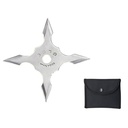
Crosswind Precision 4-Point Throwing Star - Silver
11 sold in last 24 hours
Heat still hangs over the yard when you step out, plywood tacked against a fence post and mesquite dust in the air. This balanced throwing star settles into its spin the second it leaves your fingers. Four sharp points, a clean silver finish, and a center vent that makes each throw predictable. It rides quiet in the nylon pouch until you’re ready to work a new pattern into that board. Simple, repeatable, and built for long evenings of practice.
Crosswind Control in a Texas Backyard
Late light, fence line, scrap plywood screwed to an old cedar post. You pace off ten yards in dry grass and feel a light breeze slipping across the yard. This four-point throwing star fits your fingers the same way every time. The spin starts the moment you let go, and you can read its path against the board like you’d read a cow trail in dusty caliche.
The Crosswind Precision 4-Point Throwing Star - Silver is built for that kind of quiet Texas practice. Not a toy, not fantasy wall art. A compact, four-inch metal star with a center vent and beveled tips that’s meant to be thrown again and again until your grouping tightens and your board looks like a well-used target at a rural range.
How a Balanced Throwing Star Earns Its Place in Texas Practice
Texas land is wide and usually windy. A sloppy throwing star will show it. This one holds its line. The four arms are cut to a true cross, each point matching the next, so the weight sits even around that center vent hole. When you snap it forward, it doesn’t wobble or hunt for direction; it settles into its spin like a truck finding the groove in a rutted lease road.
The satin silver finish keeps glare down when the sun is low over a San Angelo pasture or bouncing off tin roofs in a Houston back lot. Edges are sharply defined at the tips, with a controlled bevel along each arm, so you get bite on wood backers without feeling like you’re handling a razor blade between throws. The compact four-inch diameter means you’re not wrestling a big, awkward disc. You’re working with a star that feels more like a well-balanced side tool than a showpiece.
Built for Texas Training Routines, From Back Alley to Back Forty
Throwing weapons live or die on repetition. Down a side street in Dallas behind a strip of shops, a plywood panel leaned against a cinderblock wall is enough. Out on a place near Kerrville, maybe it’s an old stall door repurposed as a target. The Crosswind’s one-piece metal construction and central vent keep your throws consistent no matter where you practice.
The center hole isn’t decoration. It gives your fingertips a fixed index point and lets air pass cleanly through the middle of the star. That means less drag and a truer spin when a Hill Country gust kicks up between houses or across a stock tank. The curved inner cutouts between arms are there to trim excess mass and keep the rotation smooth, so you’re training your muscle memory instead of fighting bad balance.
After a few sessions, you don’t think about the tool. You think about distance, angle, and the sound of steel finding wood. That’s the mark of a good throwing star in any Texas setting, from a concrete patio in Lubbock to a shaded carport in Corpus.
Carrying and Storing a Throwing Star in Texas Life
Most folks here keep this kind of tool close to where they practice. Tucked in the console of a truck that backs up to the same target every weekend. Sitting in a drawer by the back door, waiting for another half hour of throws before dark. The included black nylon pouch makes that easy.
The sheath is plain, tough fabric that snaps shut over the star and drops into a range bag or glove box without fuss. No bulk, no bright colors, nothing to catch on other gear. In a state where gear tends to pile up—ropes, gloves, small tools—having a flat, simple pouch matters. You can stack this star with others, or carry a single trainer to your buddy’s place without advertising what you’ve got.
For collectors, the clean satin silver finish and minimalist engraving near the center vent make it as at home on a shelf as it is in a practice lane. But it was built first to fly, not just to sit under display lights.
Texas Law, Training Use, and Common-Sense Carry
Texas relaxed most of its old knife restrictions years back. State law now treats many edged tools, including throwing stars, more like any other bladed implement, with the main concerns being location and intent. In most everyday situations—your own property, a buddy’s place, private ranges—using a throwing star like this for practice or skill training sits in the same category as working with axes at a backyard target or blades at a camp setup.
Where Texans still need to pay attention is location. Certain places—schools, courthouses, secured government buildings, and some events—maintain strict rules on weapons of any kind. Walk into a courthouse in Brady or a high school gym in Amarillo with this in your pocket and you’re asking for a problem, just as you would with any other obvious weapon.
The right way to use the Crosswind is simple: keep it as a training and target tool on private land or at a spot where permission and local rules are clear. Transport it in its pouch, tucked away with the rest of your training gear. If questions come up, be straight about what it is and how you use it—practice, collection, or display—because in Texas, honest purpose carries weight.
This isn’t advice for every edge case in every county. City ordinances and venue rules can be tighter than state law. When in doubt, check local regulations or ask ahead, the same way you would before bringing any other training weapon or tool onto someone else’s property.
Questions Texas Buyers Ask About Throwing Stars
Are OTF knives legal to carry in Texas?
Yes. Texas removed the old ban on switchblades and automatic knives years ago, so an OTF knife is legal to own and carry in most of the state, just like other blades. The real limits now are about where you bring it—schools, secured government buildings, some events, and a few posted locations remain off-limits or restricted. Age and intent can matter too in touchy situations. Treat an automatic knife like any serious tool: carry it discreetly, use it responsibly, and know the rules for the specific place you’re walking into.
Can I legally own and practice with a throwing star in Texas?
In most cases, yes. On your own property or with permission on private land, using a throwing star like this for target practice is generally treated the same as working with any other bladed throwing tool. The key is where and how you use it. Don’t carry it into schools, courthouses, airports, or posted venues, and don’t walk around brandishing it in public. Keep it in its pouch with your training gear, use it on a proper target, and you’re aligned with how most Texans—and most Texas officers—expect a responsible owner to behave.
Is this the right throwing star for a Texas beginner?
For most new throwers here, it’s a smart place to start. The four-inch size is big enough to stick reliably into the kind of scrap lumber and fence boards we actually have lying around, but small enough to stay comfortable in smaller hands. The balanced cross pattern and center vent keep the flight predictable, so you’re learning distance and release instead of wrestling design flaws. If your plan is backyard or ranch-line practice after work, one or two of these stars and a solid backer board are all you need to get serious about your throws.
First Throw on a Hot Evening
The sun is down behind the neighbor’s roof in San Antonio, or behind a windmill east of Abilene, and the heat’s finally letting go. You walk out with the nylon pouch in hand, snap it open, and feel the cool, flat silver star settle into your grip. Ten yards out, the board waits.
One step, one throw. The Crosswind leaves your fingers already spinning, tracing a clean line through still air or a faint cross breeze. The sound of it biting into wood cuts through the evening traffic or the cicadas. You pull it free, feel the same balance in your palm, and throw again.
Out here, repetition is its own reward. No crowds, no noise. Just you, a target, and a tool that turns Texas space—alley, yard, pasture—into a quiet training range.