

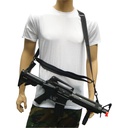
Dustline Control Three Point Rifle Sling - Coyote
6 sold in last 24 hours
Out on a caliche lease road or moving a gate on fence-check, there’s always that moment you need both hands free. This three point rifle sling locks your carbine close, then lets it drop and hang under control the second you need it gone. Adjustable for fixed or collapsible stocks, it rides tight, then releases clean when it’s time to bring steel back up. The coyote finish just disappears into dust, mesquite, and concrete. This is how Texans keep a rifle ready without white-knuckling it.
When Your Rifle Has to Move With You, Not Against You
West of Weatherford on a dry lease road, you step out to drag a gate. The wind kicks up dust, the kind that settles on your boots and finds every bit of metal you own. You still need your rifle close, but you can’t waste a hand babysitting it. This three point rifle sling was built for that moment — when control matters more than comfort, and you don’t have time to think about how your rifle is hanging.
Wrapped across your chest and shoulder, the sling pulls the rifle in tight while you climb into a blind, lean into a barricade at a range day in San Angelo, or move from truck to treeline on hog control. Drop the rifle and it doesn’t swing wild. Bring it back up and it’s right where it needs to be. That’s the point of a real patrol-ready setup.
Why This Three Point Rifle Sling Belongs In Texas Carry Culture
In this state, a long gun is as common in the truck as a cooler. On ranch roads in the Panhandle, along the river south of Del Rio, or parked under an oak at a Hill Country range, you see rifles propped, slung, and carried every way a man can figure. A basic two point works fine until you’re climbing a ladder stand with one hand and holding onto wet steel with the other. That’s where this three point rifle sling earns its keep.
The three point design anchors the rifle at multiple spots on your body, so the barrel tracks with you instead of swinging like dead weight. Adjustments let you cinch it high and tight when you’re in and out of the cab in Houston traffic, then loosen it enough to shoulder smoothly when you hit a pasture gate line outside of town. It turns your rifle from something you manage into something that just rides with you.
Retention, Transitions, and Real-World Texas Movement
If you’ve ever been on a night hog hunt outside Abilene, you know how many times you go from glassing to shooting to dragging. In those gaps, you either lay the rifle down or you live with it banging off your knees. This three point rifle sling solves that. Drop the rifle from your shoulder and it settles into a stable carry in front of you, muzzle under control, ready to come back up without fighting the sling.
Running a carbine class under a tin roof range near San Antonio, you’ll notice how much time gets lost untangling cheap straps. Here, the sling’s geometry keeps the rifle oriented the same way, no matter how many reps you’ve done. It’s not about fancy hardware. It’s about not having to think when you switch shoulders around a barricade or move from truck bed to prone in the grass.
The adjustable webbing handles everything from a fixed stock ranch rifle to a collapsible-stock patrol carbine. Set it once for plate carrier and once for a T-shirt, and the carry position stays predictable whether you’re in August heat in Laredo or a cold front north of Amarillo.
Coyote Finish That Belongs In Texas Country
The coyote color isn’t fashion. It’s function. In red dirt outside Lubbock, on chalky caliche in the oil patch, and in the tan dust that hangs over San Angelo stockyards, this sling just blends. It doesn’t shine, doesn’t shout, and doesn’t glare in a mesquite thicket when you step off the sendero at first light.
On a concrete bay in Dallas or Austin, the same coyote tone disappears into shadow and steel. When you’re carrying a rifle in public view — from a private range to the back forty behind the house — quiet gear matters. A neutral sling that looks like it belongs there draws less attention than bright nylon or glossy hardware. It’s another reason this setup fits the way Texans actually carry long guns, not the way catalog photos pretend they do.
Texas Rifle Laws, Practical Carry, and Sling Choices
In Texas, carrying a rifle openly is generally legal, whether you’re walking to your truck with a cased gun after a match in College Station or stepping out at a gas station on the way to camp. But legal doesn’t mean careless. How that rifle rides on your body matters, both for safety and for how other people read the situation.
Why a Stable Sling Matters Under Texas Law and Eyes
The law expects you to handle a firearm responsibly. A three point rifle sling that keeps the muzzle controlled and the rifle close helps you do exactly that. Instead of a loose strap letting your barrel sweep the ground or nearby people when you bend and turn, this setup lets you tighten the rifle into a safe, predictable position against your body. On a crowded range or walking from truck to door, that kind of stability is just good sense.
For landowners, outfitters, and anyone who carries a rifle in front of clients or guests, a controlled sling setup shows you take safety seriously. No drama, no theater — just a rifle that stays where it should, pointed where it should, every time you move.
Questions Texas Buyers Ask About Three Point Rifle Slings
Are OTF knives legal to carry in Texas?
They are. Under current Texas law, automatic knives and OTF (out-the-front) blades are legal to own and carry for most adults, with location-based restrictions that treat them like other "location-restricted" blades. That means you still avoid places like schools, certain government buildings, and similar restricted locations. Same mindset applies to long guns: legal doesn’t replace common sense. You carry in a way that keeps the people around you safe and at ease.
Will this three point rifle sling work with my AR and my old deer rifle?
Yes. The strap system is built to adjust around both collapsible and fixed stocks, so the same sling can live on an AR carbine you run at a class in Waco and swap over to the beat-up .308 that’s ridden your South Texas lease for twenty seasons. You set your carry height and tension once for each rifle, and the sling does the rest.
Why choose a three point over a basic two point sling in Texas?
If your rifle mostly sits in the rack between shots, a two point works fine. But if your days look like opening and closing ranch gates, climbing ladder stands, dragging hogs to the side of a field, or moving through a full course at Rifles Only on the coast, the extra control of a three point rifle sling pays off. It lets you go hands-free without losing track of the rifle’s position, and brings it back on target faster when coyotes step out on a sendero or steel starts ringing on the line.
Patrol-Ready From Lease Road to City Range
Picture stepping out of your truck before first light on a stretch of land outside Uvalde. The wind is still, the caliche carries every sound, and you’ve got a pack, a call, and a rifle that has to stay with you all morning. You clip in, settle the three point rifle sling across your chest, and the rifle tucks in like it belongs there. Walking to the stand, climbing the ladder, shifting to sit, you don’t think about the sling. The gun just stays put.
Hours later, that same rifle rides back across a concrete bay in town for a quick zero check, the coyote webbing fading into steel and shadow. Different setting, same carry. The sling hasn’t stretched, twisted, or slipped. It’s still doing what it was built to do — keeping a Texas rifle where it should be: under control, within reach, and ready.