Eagle Doctrine Rifle Maintenance Manual - White Cover
7 sold in last 24 hours
West of Abilene, a dusty shooting bench and a well-used rifle don’t leave much room for guesswork. This Eagle Doctrine Rifle Maintenance Manual lays out M16A2 care the way Marines learn it: clear diagrams, step-by-step checks, and parts IDs you can follow tired, sweaty, or under a red lamp. Slim enough for a range bag or truck door pocket, it turns armorer-level detail into field-ready answers when a Texas rifle starts to act different.
Doctrine on Paper for a Rifle That Has to Run
On a 102-degree afternoon outside Killeen, mirage rolling off the berm, a finicky rifle will show you every mistake you made last time you cleaned it. That’s when this Eagle Doctrine Rifle Maintenance Manual earns its keep. Born from U.S. Marine Corps technical doctrine, it treats the 5.56mm M16A2 like what it is in Texas too: a working rifle that doesn’t get to fail when the wind kicks sand across the line.
Black-and-white diagrams, mil-spec language, and tabbed sections keep things simple when your hands are slick and your patience is thin. It’s not a coffee-table book—it’s a bench, tailgate, and range-shed manual for Texans who’d rather fix a problem themselves than box the rifle up and ship it off.
Why a Texas Rifle Owner Reaches for This Manual First
Plenty of books talk about rifles. This one tells you exactly what to do with an M16A2-pattern gun when something feels off. Gas system acting strange after a dusty day near Lubbock? You can walk the system front to back with exploded views and part numbers. Zero won’t hold at the Panhandle range? The step-by-step checks for sights, mounts, and mechanical issues are laid out, not guessed at.
The white softcover rides flat against a ruck panel, range bag sleeve, or the side pocket of the truck you park under a live oak on the back of the lease. Perfect binding keeps pages in order when it’s been tossed, stacked, and slammed in a toolbox more than once. Inside, the technical tone matches what armorers and instructors use, so you’re not translating somebody’s opinion—you’re reading the same style of doctrine that trains Marines.
Texas OTF Knife Buyers Still Run Rifles by the Book
The kind of Texan who cares enough to research an OTF knife for everyday carry usually cares just as much about how their rifle runs. The same discipline that has you checking blade lockup in a Hill Country cabin after a long day of cutting cordage shows up here when you’re breaking down a rifle on the tailgate.
This manual matches that mindset. It’s direct. It’s procedural. It doesn’t care how long you’ve been shooting; it lays out organizational and intermediate maintenance as if you’re learning it fresh. For a Texas buyer who sees their OTF knife and their rifle as parts of the same readiness kit—truck console, safe, range locker—this book closes the loop. Knife for close work, doctrine for long guns, all squared away before another trip to the lease or out to the pasture range.
Legal Reality and Rifle Responsibility in a Texas Kit
Texas law is clear about rifles: there’s no state-level registration, and long guns ride behind truck seats, in ranch buggies, and in gun cases from Amarillo to Brownsville without much attention. But that freedom comes with an unspoken expectation—if you’re going to keep a rifle handy in this state, you keep it safe and serviceable.
Why Maintenance Matters as Much as Marksmanship
On public land outside San Angelo or at a private range near Dallas, nobody’s impressed by tight groups if your rifle chokes halfway through a string. Carbon-packed bolts, worn springs, and ignored wear points cause the kinds of malfunctions that turn a comfortable Texas morning on the line into a long walk back to the truck. This manual walks you through inspections and part replacements the way a unit armorer would, so you can fix problems before they show up under recoil.
For the same buyer who checks Texas knife laws before clipping an OTF into their pocket, this book scratches that same itch for doing things right—knowing the standard, following the sequence, and not cutting corners because the rifle "seems fine."
USMC Doctrine, Texas Conditions
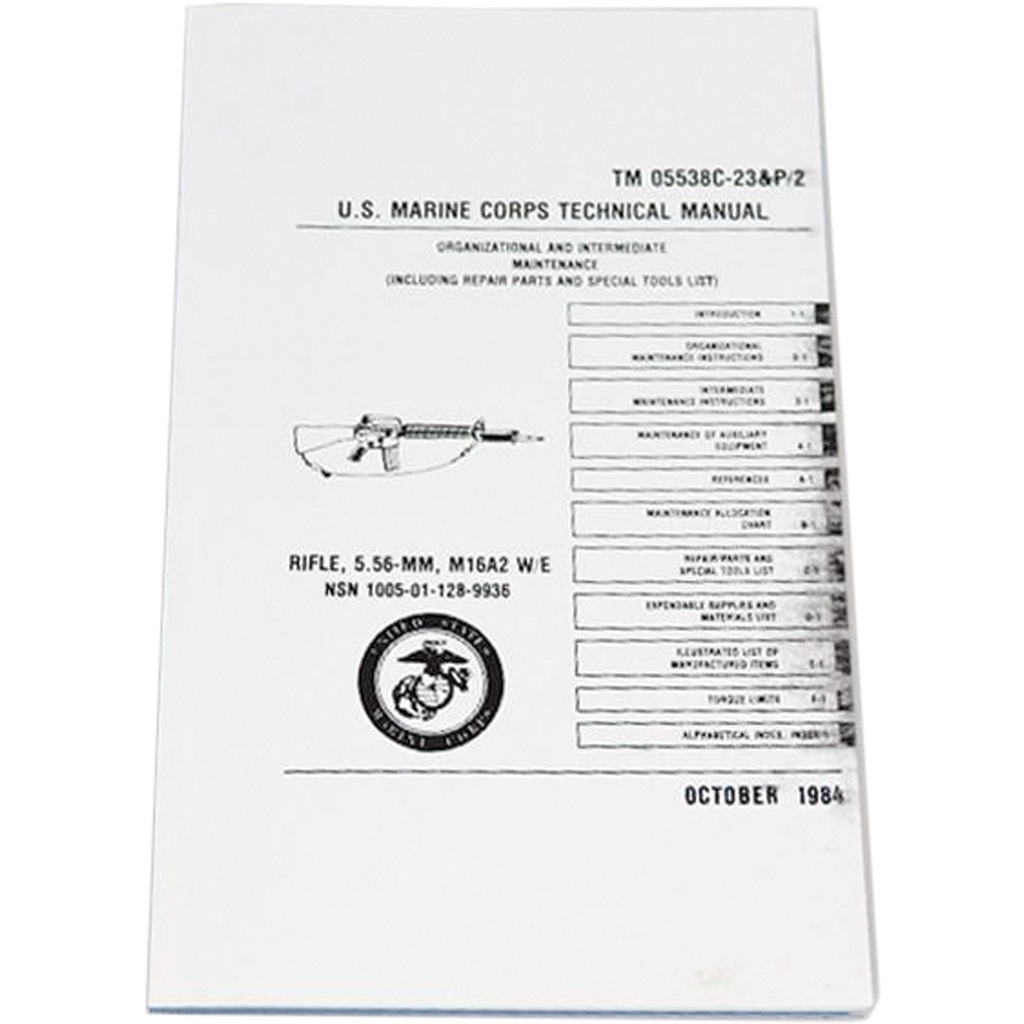
The cover reads like what it is: "U.S. MARINE CORPS TECHNICAL MANUAL" across the top, with the eagle, globe, and anchor stamped near the bottom. An M16A2 in clean line art runs through the center, backed by a tabbed index that hints at how much detail lives inside. It’s October 1984 on the cover, but the content still tracks with any Texas-owned M16A2-style rifle or clone built on the same system.
Heat, dust, and time don’t care what patch you wear. On a lease outside Junction, rifles live in scabbards and ride in the dust cloud behind a UTV. In West Texas, high wind and sand find every gap in your gun. The organizational and intermediate maintenance steps in this manual—cleaning intervals, detailed disassembly, part inspection—were written for field conditions that feel a lot like a long summer in the Big Bend region.
From Armory Bench to Texas Tailgate
What starts on a Marine armory bench translates cleanly to a folding table at a backyard range in Katy. The manual’s pacing is slow and methodical: identify the part, understand the function, follow the diagram, complete the task. That rhythm works just as well when you’re teaching a new shooter how to respect the rifle as when you’re alone, chasing down a stubborn malfunction before deer season opens.
Questions Texas Buyers Ask About Rifle Maintenance Manuals
Are OTF knives legal to carry in Texas?
Yes. Under current Texas law, OTF knives and other automatic knives are legal to own and carry for adults, as long as you’re not carrying into specific prohibited locations like certain schools, secure government areas, or places with posted restrictions. Many Texans who keep an OTF knife in their pocket also keep a rifle manual like this one in the truck, so both tools are used safely and responsibly.
Will this manual help with my AR-15 in Texas?
If your AR-15 is built on the same basic system as an M16A2—and most are—the procedures in this manual line up closely with what you’ll see in your own rifle. Gas system layout, bolt carrier group function, and basic troubleshooting walk the same ground. For a Texas shooter running drills outside Waco or checking zero before a Panhandle hunt, it gives you a disciplined, doctrine-level way to diagnose and maintain your rifle even if it’s not a stamped military gun.
Is this better than just watching online videos?
Videos help until your cell signal drops on a ranch road outside Uvalde or the tablet dies in a hot truck. This manual doesn’t care about batteries or bandwidth. It lays flat next to a rifle on a workbench or tailgate, and you can flip straight to the tabbed section you need. For Texans who like to have a reliable fallback when plans go sideways—same reason they carry an OTF knife instead of relying on whatever’s lying around—the permanence of printed doctrine is worth the small space it takes in a bag.
Ready When a Texas Rifle Has Something to Say
Picture a late-season evening near Llano. Wind easing off. You’re on the bench behind the house, working through a new load. The rifle throws a flyer, then another, and the bolt starts to feel rough on the return. Instead of guessing, you crack open the Eagle Doctrine Rifle Maintenance Manual on the tailgate, follow a familiar diagram, and break the gun down with the same calm you use opening your OTF knife one-handed.
Carbon gives up to solvent. Worn part gets replaced. Rifle goes back together by the book. The sun drops behind the live oaks, and when you step back to the line, you know the gun is right because you didn’t improvise your way through it. In a state where rifles live hard and get used often, that quiet confidence is worth more than any sales pitch—just a Marine-style manual, doing its job in a Texas yard.