Imperial Laurel Legionnaire Gladius Sword - Wood Handle
8 sold in last 24 hours
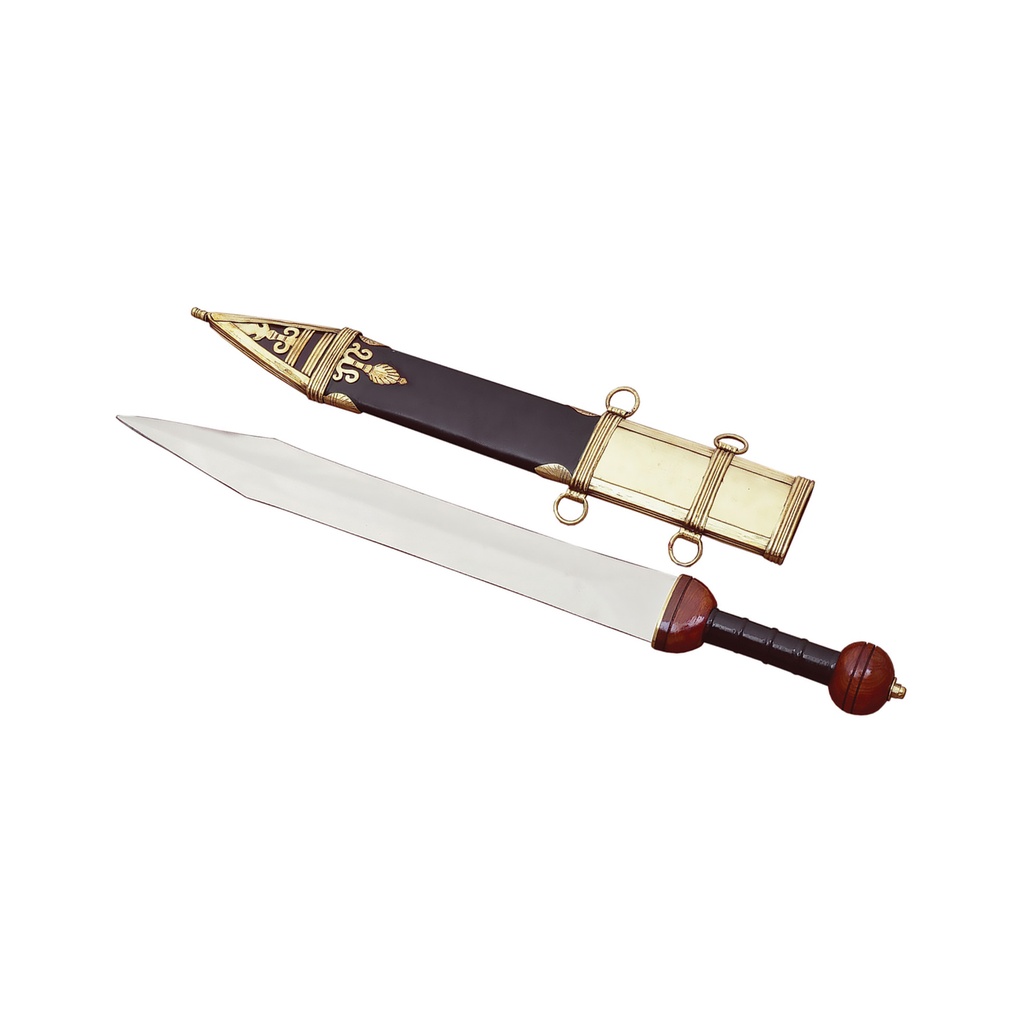
Hang this Roman gladius replica where the light hits it—over a stone fireplace in the Hill Country or along a study wall in Houston. The polished 27-inch short sword, wood handle, and black-and-gold laurel scabbard bring old-world command into a modern Texas room. It’s balanced, detailed, and built to be noticed. You’re not just filling wall space; you’re choosing the one piece that always starts the story.
When a Roman Gladius Belongs on a Texas Wall
Out past Fredericksburg, you’ll see ranch houses where the walls tell a story—old Winchesters, cavalry sabers, a few family heirlooms over a limestone mantle. This Imperial Laurel Legionnaire Gladius Sword fits right into that mix. A Roman short sword, polished and balanced, set against Texas stone and cedar. It doesn’t try to look rustic. It brings a different kind of history into the room and holds its own.
This isn’t a fantasy piece. It’s a straight double-edged Roman gladius, about 27 inches overall, with a spear-point tip and a grip that feels like it was meant to ride at a soldier’s hip. For a Texas collector, it’s the answer when a stamped-out wall hanger just won’t do.
Imperial Detail, Built for a Texas Display
Walk into a study in Dallas or a home office in Austin and you know in three steps whether the blades on the wall are serious. This gladius earns its place before you touch it. The polished silver blade runs just under 20 inches, straight and even, with a true spear point that tracks clean from guard to tip. It looks cut from one line, not three different ideas.
The handle is warm reddish-brown wood, turned in gentle segments so your fingers find their place without thinking. No plastic, no fake grain. Just wood with enough shape to stay in the hand when you test the balance.
The guard and pommel run gold, not gaudy, with a small finial at the end that finishes the profile the way a good set of spurs finishes a pair of boots. Slide the blade into the scabbard and the look changes: black and gold, laurel and banding, four suspension rings catching the light. On a wall in San Antonio, over a bar in Lubbock, that sheath does as much talking as the blade.
How a Roman Gladius Fits Texas Rooms and Routines
In Texas houses, space matters. Big walls, long halls, open kitchens that roll straight into a living room. A full-length sword can vanish in all that distance. A 27-inch gladius doesn’t. It anchors a smaller section of wall—above a bookshelf in a Houston townhouse, next to framed maps in a Midland office, over a gun safe in a Panhandle ranch house.
The short-sword form works for desk displays too. Lay the sword in front of its scabbard on a credenza in a Fort Worth law office and it reads like a Roman officer set it down to sign papers. The laurel motif on the black-and-gold scabbard throat catches the eye first, then the gold bands and rings pull the gaze along the length. When you draw the blade halfway, that bright edge and spear point say this isn’t just decor—it’s a weapon pattern that once decided battles.
Collectors who already own Texas bowies and Western-themed blades use this gladius to break the pattern. It brings order and empire into a room full of open country and cattle brands. That contrast is what makes it work.
Texas OTF Knife Buyers and the Roman Short Sword Mindset
The same person asking where to buy an OTF knife in Texas is often the one who wants a wall piece with backbone. OTF knives ride in the pocket or truck console; swords like this gladius command the room you come home to. Both scratch the same itch for real steel and reliable build.
If you pay attention to deployment and balance in a Texas OTF knife, you’ll notice similar things here. The blade sits straight in the scabbard with no rattle. The draw is smooth, seating and unseating with a quiet finality. When you hold the sword at the guard, it doesn’t nose-dive. The balance sits back toward the hand, like a good, compact fighting blade should. That’s what Roman soldiers trusted day after day. It’s also what makes this comfortable to handle when you pull it down to show a guest in El Paso or Corpus.
Texas Context, Knife Laws, and Where This Gladius Lives
How Texas Knife Laws Treat a Roman Gladius
Modern Texas knife law is straightforward about longer blades. State law allows large knives, including swords and long fixed blades, but it restricts how and where they can be carried in public. In most day-to-day situations—walking into a grocery store in Waco, sitting in a restaurant in Amarillo—you’re not carrying a 27-inch gladius on your belt. This piece is meant for the home, the office, the private shop, the man-cave over the garage.
Where Texas buyers worry most about legality is with OTF knives and switchblades, not display swords like this. State law opened the door for automatic knives and OTF carry, with specific location limits. That’s why Texans dig into questions like “are OTF knives legal in Texas” and “what can I carry into a school or courthouse.” A historical short sword like this lives on the wall, on a stand, or in a private collection, well away from that daily-carry conversation.
Display Scenarios Only a Texan Thinks About
Picture this sword in a Hill Country rental cabin—stone fireplace, heavy timber mantle, longhorn mount on one wall, this black-and-gold gladius running clean across the other. Or in a Houston high-rise study, set between shelves of leather-bound books and a framed oilfield map. In each case, it does the same job: signals that whoever owns this place respects blades and history enough to choose something specific, not mass-market clutter.
In a Panhandle shop, it might hang above a glass case of OTF knives and folders, marking the top shelf of the collection. In a small-town police chief’s office, it might sit on a stand behind the desk, a reminder that command and discipline didn’t start with modern uniforms.
Questions Texas Buyers Ask About Roman Gladius Swords
Are OTF knives legal to carry in Texas?
Yes. Under current Texas law, OTF knives and other automatic knives are legal at the state level, with restrictions on certain locations like schools, courthouses, and some government buildings. Blade length and local rules can still shape how and where you carry. That’s why most Texans treat an OTF knife as a practical everyday tool—kept in pocket, in a work truck, or on a ranch—while a full-length sword like this gladius stays in the house or office as a display piece.
Can I keep this Roman gladius sword on display in my Texas home or office?
Yes. Texans across the state display swords, sabers, and long knives in private homes, shops, and offices. This gladius is built for exactly that kind of setting. Mount it over a fireplace in Kerrville, on a wall rack in Laredo, or on a stand behind a desk in Plano. It stays put, becomes part of the room, and doesn’t tangle with public carry concerns.
How does this pair with a Texas OTF knife collection?
If your safe already holds OTF knives for everyday Texas carry, this gladius becomes the anchor for your display side. OTF knives answer the question, “What do I trust in my hand on a long day in the field or on the job site?” A ceremonial Roman short sword like this answers, “What do I want people to see when they step into my space?” It gives your collection range: modern mechanism on your belt, old-world steel presence on your wall.
Putting This Gladius to Work in a Texas Setting
Imagine the first time you hang it. Maybe it’s a brick wall in an Austin bungalow, maybe knotty pine in a lake house on Toledo Bend. You lock the brackets down, set the black-and-gold scabbard in place, then rest the wood handle and gold guard where they belong. The room changes. Light hits the laurel and the blade, and people stop when they pass that wall.
Later, you take it down and lay it across a table for a guest—blade out of the scabbard just enough to show the line and shine. No speeches, no sales pitch. Just steel, wood, and history sitting quiet in a Texas room. That’s when you know it fits.