Midnight Flow Control Nunchucks - Grooved Black
4 sold in last 24 hours
Late night in a hot Houston garage, fan humming, bag already worked over—you reach for the nunchucks that never fight you. The grooved handles lock into your grip when the sweat starts, while the ball‑bearing chain keeps each rotation smooth and predictable. Light, balanced, and all business in midnight black, these nunchucks are made for steady drills, tight control, and clean recoveries. For Texas dojos and back‑yard training alike, they feel right from the first spin.
Midnight Practice Nunchucks Built for Real Texas Training
Garage door halfway open, night air still warm, concrete floor dusty from the day. In a Dallas suburb or a small town off Highway 6, the routine looks the same—bag work, footwork, then nunchucks. When the house is quiet and the cicadas start up, these Midnight Flow Control Nunchucks - Grooved Black earn their place in your hands.
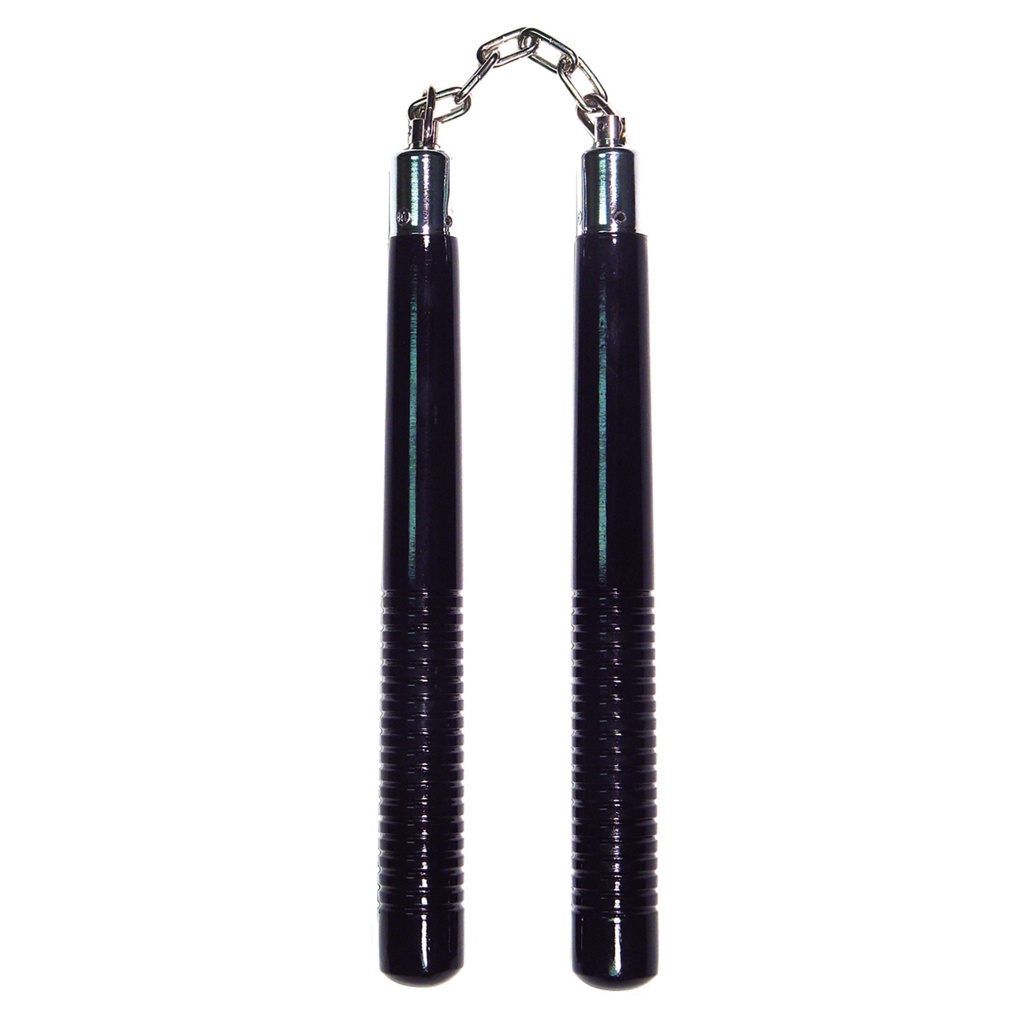
They’re not flashy. No dragons, no bright paint, nothing to distract from what matters. Just two midnight black handles, grooved where your fingers need bite, smooth where they should glide, tied together with a short chain on ball‑bearing swivels that keep the rotation honest. Built for the kind of steady, repeatable practice Texans put in after the sun finally drops.
Control and Flow for Texas Dojos and Back‑Yard Sessions
Across Houston strip‑mall dojos and converted barns outside Lubbock, the story is the same: control beats showmanship. These training nunchucks were put together with that in mind. The handles are straight, cylindrical, and evenly balanced, so whether you’re in a San Antonio school with mats on the floor or working footwork on a cracked Amarillo driveway, the feel doesn’t change.
The lower section of each handle is cut with deep horizontal grooves. That texture matters when the West Texas heat or a Central Texas garage session leaves your palms slick. Instead of slipping or over‑gripping, your fingers find natural tracks. The upper section stays smooth to let the nunchucks slide across the back of your hand or under your arm without grabbing fabric. It’s a small detail that makes long runs of passes, figure‑eights, and shoulder transitions more forgiving.
The midnight black finish keeps reflections down under bright gym lights and looks clean under softer porch light. It gives these nunchucks the same quiet, purposeful presence Texans expect from their working gear—tools that look right without shouting for attention.
Ball‑Bearing Chain That Keeps Your Flow Honest
From Austin rec centers to small schools outside Beaumont, serious students know the weak link in most nunchucks is the hardware. These use a short metal chain set on ball‑bearing swivels at each handle. That setup matters. Instead of the stick‑and‑jump feel you get with stiff connections, this chain lets the nunchucks roll over, under, and around with a smooth, predictable arc.
Each rotation tracks clean, which means when you mis‑time a pass, you feel the mistake instead of blaming the gear. For instructors teaching basics to beginners or drilling advanced flow in a Corpus Christi dojo, that consistency builds confidence. The chain length keeps the arc tight enough for indoor practice—no need for a big yard or high ceiling, just a clear pocket of space and focus.
Texas Concerns: Where Nunchucks Fit Into State Weapon Laws
Anyone serious about martial arts in this state eventually asks how training weapons fit into Texas law. While Texas has loosened a lot of its weapon restrictions in recent years—folding knives, autos, even some blades that were once off‑limits—impact and flexible weapons still live in a narrower lane.
Unlike an OTF knife Texas buyers might carry day to day, nunchucks are generally training tools or demo pieces, not something you keep on your belt at H‑E‑B. Texas law focuses more on how and where an item is carried and used than on owning it at home or in a controlled training space. That’s why you see these in strip‑mall dojos from El Paso to Tyler without issue, but you don’t see them clipped to jeans at the Buc‑ee’s soda fountain.
Common‑sense rule: keep them in the gym bag, at the school, or on the home rack. Use them where they make sense—on mats, in garages, barns, or proper training spaces—not in parking lots or public sidewalks. Texans take pride in knowing the difference between gear for practice and gear for daily carry, and these belong firmly in the practice lane.
How Texas Training Culture Shapes Gear Choice
Texas schools mix old‑school striking, modern MMA, and traditional weapons work. That blend changes what people buy. A student in Plano might carry a compact Texas OTF knife for everyday chores but reach for chain nunchucks like these for coordination, timing, and discipline work at night class.
Instructors favor tools that survive being dropped on rough floors, tossed in bags, and used night after night. The metal end caps and swivel hardware on these nunchucks are made for that grind—tight tolerances, clean spin, no decorative parts waiting to break off. They feel the same on week thirty as they did on week one when you learn your first simple spin.
Built for the Long Haul: Texas Training, Texas Heat
Heat and repetition expose weak gear fast. In a non‑air‑conditioned gym outside Waco or a cluttered garage in McAllen, anything with soft finishes or loose hardware starts to show it. These nunchucks answer that with a straightforward build: hard, glossy black handles that resist scuffs, solid metal caps that protect the ends when they hit floor or wall, and hardware designed to spin clean under pressure.
The symmetry of the design matters during longer flow sets. Both handles match—same weight, same cut grooves, same smooth upper sections. That balance keeps fatigue from driving sloppy movement too early in a session. The more predictable the feel, the more your hands and shoulders learn the path, not the quirks.
From First Spin to Advanced Flow in Texas Spaces
Whether it’s a kid’s first weapons class in a Midland strip‑mall dojo or a seasoned practitioner refining behind‑the‑back passes in a Fort Worth gym, these nunchucks keep the learning curve honest. Light enough that mistakes don’t punish too hard, solid enough that you respect every swing.
Because the chain keeps arcs compact, they fit tight spaces—shared apartments in San Marcos, dorm rooms in College Station, or a narrow side yard in Brownsville. Clear a six‑foot circle, check the ceiling fan, and you’ve got enough room to train.
Questions Texas Buyers Ask About Training Nunchucks
Are OTF knives legal to carry in Texas?
Texas law has opened up significantly on automatic knives. Under current statutes, OTF knives and other switchblades are legal to own and carry in most everyday situations, as long as you respect location restrictions and the broader rules about "location‑restricted" knives. That’s why the search for the best OTF knife in Texas has grown—Texans can now legally carry tools that used to stay in the drawer. Nunchucks like these, by contrast, live mostly in training spaces, not on your person in public.
Can I practice with these nunchucks in my Texas apartment or yard?
Inside your own space—a Denton apartment, a backyard in Sugar Land, a rented house near Abilene—you’re generally free to train with martial arts gear like nunchucks. The smart move is respecting noise, neighbors, and common areas. Keep practice in your unit, garage, or fenced yard, not shared walkways or parking lots. Texans value handling their business without dragging other folks into it.
How do I choose between an OTF knife and training nunchucks for my needs?
It comes down to purpose. If you’re looking for a daily tool you can legally carry across most of the state, an OTF knife Texas buyers trust makes sense—box cutting in a Houston warehouse, ranch chores near Kerrville, glove‑box backup in a West Texas truck. If your goal is coordination, discipline, and weapons training, these midnight black nunchucks belong in the gym bag instead. Many Texans own both: one for carry, one for the grind of training.
Midnight Black in a Texas Night: Where These Nunchucks Belong
Picture the end of a long August day in Central Texas. The sun finally lets go, crickets start, and the heat in the garage drops from brutal to bearable. You sweep a clear space on the concrete, grab the midnight black handles from the workbench, and feel the grooved grip settle into your fingers.
The first spin is slow, chain whispering as it rolls over your shoulder. Second pass comes smoother. Third finds a rhythm. Out past the driveway, traffic hums along the frontage road, but in that narrow cone of light under the bare bulb, it’s just you, breath, and the arc of those black handles. No noise. No flash. Just control, repetition, and the kind of quiet work Texans have always trusted more than talk.