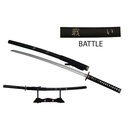
Midnight Kanji Showcase Samurai Sword - Black Finish
8 sold in last 24 hours
In a Dallas loft, in a Hill Country media room, this midnight katana doesn’t shout—it anchors the room. The 40-inch silver blade, black sheath, and gold kanji read clean from across the space, while the included stand turns any shelf into a quiet stage. It’s a ready-made centerpiece for Texans who want a samurai silhouette with modern, blacked-out restraint—unboxed, set in place, and working as décor before the sun’s down.
Midnight Steel in a Texas Room
Picture a Friday night in Austin. Lights low, game on mute, friends drifting through the living room between the kitchen and the patio. On the media console, above the soundbar, sits a 40-inch curve of silver and black. The Midnight Kanji Showcase Samurai Sword - Black Finish doesn’t need neon or LED strips. The simple katana blade, the black sheath, the gold kanji, and the matching stand do the work. It feels less like a prop and more like a deliberate choice.
How a Samurai Display Sword Earns Its Place in Texas Homes
Texas rooms run big—wide walls in new builds outside Katy, long reclaimed-wood shelves in renovated Fort Worth bungalows, concrete ledges in converted downtown warehouses. A small trinket gets swallowed. This 40-inch decorative katana holds its own. The silver blade throws a clean line. The black sheath and handle keep the look contained, not gaudy. Gold kanji along the scabbard and base of the stand add just enough detail to draw a second look without turning into costume scenery.
Because the stand comes with it, you’re not hunting for brackets or measuring for wall mounts. Out of the box, it sits horizontally on a desk, mantle, store shelf, or display case and looks like it belongs there. For a Houston apartment where space runs tight, it can ride on a compact bookshelf; in a Hill Country lodge, it can sit beneath a TV or on the bar back, filling the gap between bottles and framed photos.
Display-Ready Katana Details for Texas Collectors
This isn’t a backyard cutting sword; it’s a decorative samurai piece built to be looked at. The katana-style blade runs a long, graceful curve in bright silver, enough shine to catch ambient light from a window in El Paso or a lamp in Lubbock. The sheath and handle share a uniform black finish that reads modern—more midnight gallery than museum replica.
The handle wraps in the familiar diamond pattern, black over white, grounding it in the samurai tradition that anime fans, martial arts students, and movie buffs across Texas will recognize at a glance. A simple guard and capped pommel keep the silhouette clean. No overdone spikes, no fantasy blades—just a recognizable katana form that complements posters, vinyl collections, PC rigs, and framed art without clashing.
The included stand carries matching black with gold kanji, tying the whole set together. On a glass counter in a San Antonio collectibles shop, that stand does more than hold the sword—it frames it. Customers drifting past see a finished scene, not a loose blade sliding around on a shelf.
Why This Decorative Samurai Sword Works in Texas Spaces
Texas décor isn’t one thing. You’ll see longhorn skulls in Midland, modern minimal in downtown Dallas, and anime walls in student apartments around College Station. This samurai display sword threads the needle between statement piece and subtle accent. The black finish keeps it from taking over a room full of other gear—guitars on the wall, hats on pegs, a revolver print over the bar. But when someone walks in and their eye sweeps the room, it lands here.
In a game room, the 40-inch length stretches neatly above dual monitors or under a wall-mounted TV. In a home theater, it sits low on a console, the silver blade catching the reflections from the screen. In a home office outside Frisco, it can ride behind the desk, camera-visible on video calls but quiet enough not to distract. For a Houston shop owner dressing a front window—comics, statues, imported snacks—this sword becomes the visual anchor that stops foot traffic for one more glance.
Texas Law, Display Swords, and Peace of Mind
There’s a practical piece to owning a long blade in this state. Texas changed its knife laws in 2017, removing the old limits on blade length. That means large blades like katanas and other long swords are generally legal to own across the state. This particular piece is decorative, intended for display in homes, offices, or shops. It’s not built or sold as a cutting weapon; it’s a showpiece.
Even so, a responsible Texas owner keeps two things in mind. First, display swords stay put. On a stand in a living room in Waco or behind glass in a Corpus Christi storefront, it’s art and atmosphere. Second, public carry of any long blade can still raise questions depending on location and context—especially around schools, government buildings, certain events, and private properties with posted rules. If you ever plan to move it for conventions, photo shoots, or store events, checking local ordinances and venue policies is just smart.
Display Use in Texas Homes and Shops
In practice, most buyers keep this sword exactly where it works best: as fixed décor. A Houston tattoo studio can run it above a flash wall. A Killeen game store can park it behind the register. A Plano home office can sit it under a framed print, always in view but never in the way. Because the stand is low-profile and sturdy, you’re not improvising with hooks or wires that could send it sliding during a West Texas dust storm rattling the windows or a slammed front door in a busy strip center.
Collecting Samurai Aesthetics in a Texas Context
Japanese-inspired steel has long found its way into Texas collections—anime shelves in Austin, martial arts dojos in San Antonio, and hybrid Western/Eastern walls where katanas hang across from lever guns. This decorative katana fits that lane. It’s affordable enough to be a first sword for a young collector in El Paso, and clean enough to sit alongside higher-end blades in a dedicated collection room in The Woodlands. The black-and-gold theme keeps it from looking like a toy, which matters when it shares space with serious pieces.
Questions Texas Buyers Ask About Samurai Display Swords
Are OTF knives legal to carry in Texas?
Switchblades and OTF (out-the-front) knives are legal to own and carry in Texas for adults, after state law changes removed old bans. There are still location-based restrictions—schools, certain government buildings, some events, and private properties with posted rules may limit or ban blades regardless of type. This product is a decorative samurai sword, not an OTF knife, but the same principle applies: legal to own, smart to check local rules before carrying any blade into sensitive areas or public events.
Is this decorative samurai sword safe to display around family and guests in Texas homes?
Used as intended—sheathed, resting on its stand, out of high-traffic reach—it works well as display décor in a Texas home. The blade is real metal, so it should be treated with the same respect as any long blade: keep it where kids can’t grab it freely, and make sure the stand sits on a stable surface. On a wide console in a San Antonio living room or a shelf in a Round Rock office, it’s as safe as you choose to make it.
How does this sword compare to higher-end katanas for a Texas collector?
This piece is built for display first, not for cutting practice or live training. For a Texas buyer looking to dress a room, storefront, or office with a clean samurai silhouette, it delivers strong visual impact at an accessible price point. A serious practitioner in Houston training with iaito or live blades will still want purpose-built swords for that work; this one fills the role of stage piece—reliable, good-looking, and easy to place.
First Night on the Stand
Imagine the first evening it’s in place. Maybe it’s a brick-walled downtown San Antonio apartment, maybe a cedar-and-stone house outside Dripping Springs. The sun slides off the horizon, the room goes from daylight to lamp glow, and that silver curve over black settles into the space. Friends walk in, glance once, then lean in closer to read the kanji. No explanation needed. You didn’t hang another generic print—you put a deliberate line of steel on display. In a state that respects a good blade, even a decorative one earns its spot.