
Midnight Guard Knuckle-Grip Tactical Slingshot - Black
5 sold in last 24 hours
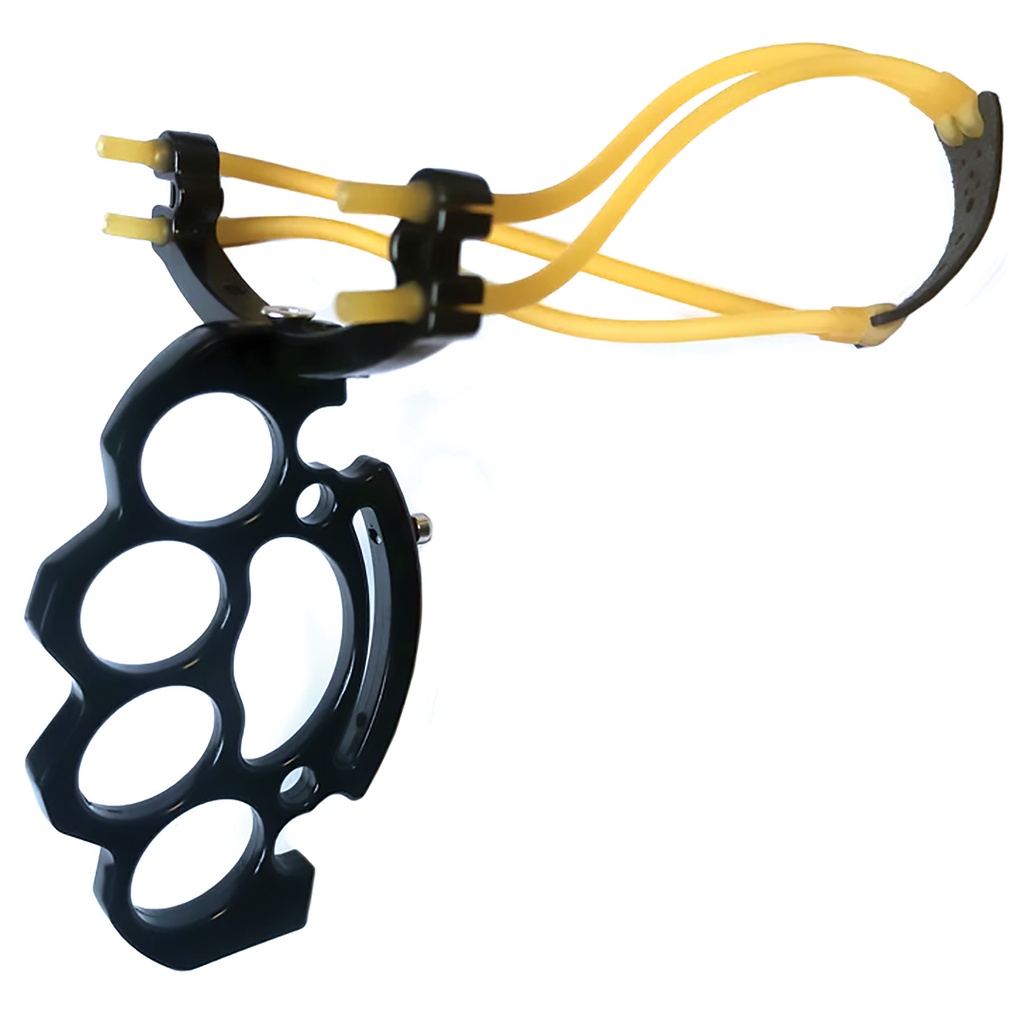
Heat’s gone, crickets are loud, and the backyard is finally yours. This knuckle-grip slingshot settles into your hand and points where your eyes are already headed. Dual yellow bands snap straight, the black metal frame soaks up recoil, and your wrist stays loose. From cans on a fence line to late-night form work on a small Texas lot, this is the kind of quiet training tool folks keep hanging by the back door.
When the Heat Drops and the Backyard Gets Quiet
Out past the last porch light, when the air finally lets up and the neighborhood settles, this knuckle-grip slingshot starts to make sense. You slip your fingers through the brass-knuckle style handle, feel the black metal frame lock into your palm, and the yellow bands pull a straight line down whatever you’ve set on that fence post. It’s the kind of tool that belongs in a Texas back yard as much as a grill and a good chair.
Control Over Power: Why This Knuckle Slingshot Fits Texas Hands
Most folks don’t talk about it, but steady aim matters more than raw pull, especially in a long Texas evening when your hands are already tired from real work. The knuckle-style grip on this slingshot spreads the force across all four fingers and the flat of your palm. Your wrist doesn’t fight the pull; it stays relaxed and straight. That means tighter groups on cans lined along a cedar fence outside Kerrville, or bottle caps balanced on T-posts behind a metal shop outside Lubbock.
The black metal frame has enough weight to sit still when the bands load up, but not so much you don’t want it in your back pocket or glove box. The dual yellow bands ride over the top, anchored into a fork built to handle repeat shots. Each draw feels the same. That rhythm is what turns a casual backyard shooter into someone who can call their hits.
Built for Real Texas Use: From Fence Lines to Lease Roads
In town, this slingshot earns its keep on a short lot, where you can only shoot down into a dirt corner between a shed and a privacy fence. Out in the country, it rides in the truck, ready for slow moments on a lease road or a dead-still afternoon at a tank dam. The bright yellow bands stay visible in low light, so you can track your sightline at dusk—when the horizon goes purple over mesquite and the light plays tricks on depth.
The pouch is cut from a perforated black material that grabs shot clean and lets go just as clean. It settles between your fingers without folding over on itself. You don’t need to think about it; your hands know where everything is. That’s the difference between a toy rack slingshot and one that sees a couple hundred rounds of practice on a Sunday.
Texas Law Context: Where a Slingshot Fits in the Gear World
Folks who come in asking about switchblades and OTF knife Texas carry rules usually ask the same thing: what’s actually legal to keep on me, and what belongs at the house or in the truck? Under current Texas law, the big legal questions circle around blades, locations, and what’s labeled as a club or prohibited weapon. A slingshot like this lives in a simpler category—it’s a tool you use on private land, on your own time, away from public streets and crowds.
Most Texas buyers treat it like they treat air rifles or steel targets: backyard or lease equipment, not something to walk around town with. Local rules and schools can still have their own restrictions, so it’s worth knowing the posted signs and house rules wherever you shoot. But in the same way you’d set up a safe backstop for a pellet gun outside Abilene or San Marcos, you give this slingshot its own lane, pointed into dirt, rock, or a target that won’t send anything back at you.
How Texas Carry Culture Shapes Gear Choices
Once Texans learn that OTF and switchblade knives are legal statewide, they usually pick a blade for daily carry and leave tools like this at the homestead or in the truck. This knuckle-grip slingshot fits that pattern: it’s not for the pocket, it’s for the property. You hang it in the garage by a nail, leave it in the console on the way to the deer lease, or keep it in the same shed where you store feed and hand tools.
Knuckle-Grip Design: Why It Shoots Different
The first time you slide your fingers through the oval cutouts, you notice it doesn’t feel like a classic forked slingshot with a skinny wooden handle. The black metal frame wraps your whole hand, with an integrated guard and palm rest that fills the hollow between thumb and forefinger. On a long, hot day along the Guadalupe or Brazos, that means less fumbling and less torque in your wrist when your grip is slick with sweat.
Draw the dual yellow bands back, and the frame doesn’t want to twist. All that pull anchors through your knuckles into the heel of your hand. The sightline settles right along the top of the fork, like pointing a finger. You can run through a string of shots at paper plates stapled to a fence rail without your forearm barking at you halfway through.
Texas-Style Targets and Training Sessions
In a Houston subdivision, this might mean a cardboard box packed with rags set in a gravel corner, bands snapping as you walk your hits in. In the Panhandle, maybe it’s a line of rusted cans wired to T-posts, swinging in the wind that never quite quits. Either way, this slingshot’s design lets you keep at it. Less hand fatigue, more time working on follow-through and release.
Questions Texas Buyers Ask About OTF Knife Texas Laws and Backyard Gear
Are OTF knives legal to carry in Texas?
Yes. Under current Texas law, OTF and other automatic knives are legal to own and carry for most adults, as long as you respect the locations where any “location-restricted knife” isn’t allowed—schools, certain government buildings, and a few other posted places. The focus is more on blade length and where you bring it, not the opening mechanism. For everyday carry across most Texas towns, an OTF knife Texas owners pick stays legal if it stays within those posted rules.
Can I practice with this knuckle-grip slingshot anywhere on my Texas property?
On your own land, most Texans treat slingshot practice like plinking with an air rifle: make sure you’ve got a solid backstop, nothing behind your target that can break or bleed, and no chance a stray shot crosses a fence line. In a tight suburban yard in Round Rock or Pearland, that usually means shooting down into dirt or into a heavy box against a fence. On acreage outside Fredericksburg or Odessa, folks still keep it pointed into a berm or tank bank rather than letting shots sail blind into brush or pasture.
How does this compare to carrying an OTF knife in Texas?
An OTF knife Texas buyers choose is for pockets, belt clips, and truck consoles—daily carry for cutting rope, hose, or boxes. This knuckle-grip slingshot is different. It’s for training sessions, small-game-style target work, and quiet evenings. You don’t clip it to your jeans for a run to H-E-B. You keep it with the rest of your shooting gear, bring it out when there’s room and time to use it right.
From First Draw to Last Light on a Texas Evening
Picture a late summer evening outside a single-story brick house in Temple. The sun’s finally off the back patio. Cicadas are loud enough to feel in your teeth. You’ve got a folding chair, a cold drink sweating on the arm, and this black knuckle-grip slingshot hanging from a nail on a treated post. You step out into the yard, slip your hand through the grip, and feel the frame settle like it’s been there a long time.
The yellow bands draw back smooth. The perforated pouch holds shot right where you want it. Cans on the fence nod one by one as the bands snap home. No neighbors bothered. No drama. Just a Texas evening, a clear line of fire, and a tool that does exactly what your hands ask of it. For anyone who already trusts an OTF in their pocket, this is what lives at the house: quiet practice, steady aim, and the comfort of knowing you can still call your shots when the light gets thin.