TrailEdge Ranch-Ready Pocket Knife Sharpener - Orange Rubber
14 sold in last 24 hours
Wind’s up on a fence line outside Lubbock and your pocket blade’s been chewing more wire than twine. This pocket knife sharpener rides on your keys, not buried in a toolbox. Dual-grit ceramic and carbide slots bring a working edge back in a few passes, even with gloves on. Bright orange rubber grips stay put in a sweaty hand or truck bed. Texans who run blades hard keep something like this close.
TrailEdge Pocket Knife Sharpener Built for Long Days and Long Roads
The workday starts before the sun clears the mesquite. Gate chains, hay twine, feed bags, a little wire you meant to cut cleaner than you did. By nine a.m., your blade is dragging instead of slicing. A full bench setup is back at the house, but this pocket knife sharpener is on your keys, already dusted in caliche, ready to bring the edge back in a handful of passes.
This is where a compact, dual-grit pocket sharpener earns its keep. Not in a shop drawer, but bouncing in a truck cup holder on I-35, clipped to a pack in the Hill Country, or hanging from a nail in a Panhandle barn.
Why This Pocket Knife Sharpener Belongs in a Texas Kit
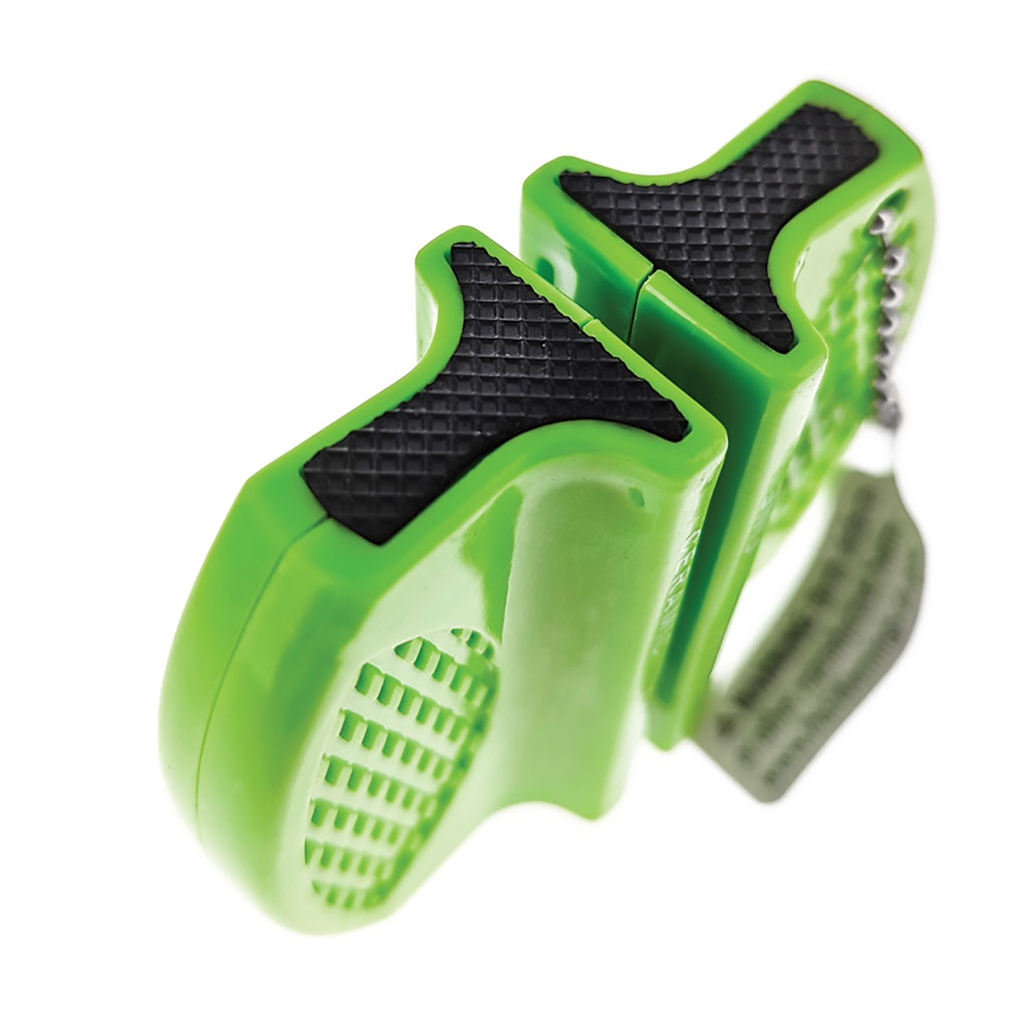
Out here, your knife rarely sees clean cardboard. It’s feed sacks, baling twine, nylon rope, irrigation hose, pecan limbs, and the odd bit of plastic strapped too tight. That kind of work rolls an edge fast. The TrailEdge Ranch-Ready Pocket Knife Sharpener answers with twin V-shaped slots: carbide plates to cut a fresh bevel into a tired blade, followed by ceramic to smooth it into a clean, working edge.
At roughly two and a quarter inches by three, it disappears in a jeans pocket or under the dash, but the bright orange rubber shell keeps it from vanishing in Johnson grass or truck clutter. Knurled grip panels lock into your hand, even under sweat, dust, or winter gloves on a Panhandle fenceline. You plant your fingers, draw the knife through, and feel the bite come back.
Field-Ready Details a Texas Knife Dealer Actually Cares About
The sharpener’s dual-sided construction isn’t about gadget points; it’s about not babying your tools. Carbide bites first, for blades that have seen a few too many pallets in a Houston warehouse or field dressing jobs in a Hill Country camp. Then ceramic plates refine that edge to something that’ll still slice paper, or more importantly, cleanly strip a wire or open feed bags without tearing.
The U-shaped body gives you something solid to hang onto in the wind on a West Texas lease or in the back of a moving work truck. Rounded corners ride easy in a pocket and don’t gouge into console plastic. The keychain loop and included chain mean it can live on your truck keys, range bag, tackle box zipper, or apron ring in a San Antonio kitchen line where house knives never seem sharp enough.
Texas OTF Knife Sharpening Without a Bench Setup
Plenty of Texans carry an OTF knife as their daily cutter now that the law allows it. Those thin, fast-deploying blades punch through shrink wrap, plastic banding, and stubborn tape better than most. The tradeoff is they lose that crisp factory edge fast if you actually use them. This pocket knife sharpener bridges the gap between a quick touch-up and a full reprofile.
Set the spine straight, draw the OTF blade through the carbide slot a few times to re-establish the bevel, then run it through the ceramic side until it feels right slicing into a scrap of cardboard or a strip of leather. No clamps, no stones, no oil. Just a stable grip and a steady pull. It’s the kind of simple, repeatable process a Texas buyer trusts because it works the same on a ranch beater as it does on a higher-end Texas OTF knife that rides in a suburban console.
Texas Knife Law, Everyday Carry, and Keeping Your Edge
Knife laws in this state used to be a patchwork headache. Not anymore. Under current Texas law, there’s no blade-length limit on knives for adults, and OTF knives and other automatic blades are legal to own and carry in most day-to-day settings. The focus now is on locations and intent, not the mechanism. That opens the door for Texans to treat OTF knives as real working tools instead of something to hide.
What hasn’t changed is how fast a working edge goes dull on Texas material. Nylon ratchet straps in an oilfield yard. Feed buckets in the heat. Zip-ties under a truck. It’s one thing to carry a legal OTF knife in Texas; it’s another to keep it sharp enough to justify that pocket space. A compact pocket knife sharpener like this one quietly solves that second problem without drawing attention or requiring a toolbox.
Sharpening on the Move in Texas Conditions
Picture a lease road outside Midland after a dust storm. Everything wears a fine layer of grit, including your knife and your hands. The rubberized orange body shrugs off that dust and still gives traction. You don’t baby it; you blow on the slots, give it a tap on your tailgate, and run your blade through. Ten seconds later, the knife bites into poly rope like it should, and you’re back to work.
Same story on a bass boat on Toledo Bend. A treble hook tangles deep in a line, and you want a clean, close cut without fraying. The bright color stands out on the deck. Ceramic plates tidy up the edge just enough to make that cut smooth without slipping.
Questions Texas Buyers Ask About a Pocket Knife Sharpener
Are OTF knives legal to carry in Texas?
Yes. Under current Texas law, OTF knives, switchblades, and other automatic knives are legal to own and carry for adults in most everyday situations. The major statewide restrictions that used to target switchblades were removed. The law now focuses more on where you carry and how you use a knife than whether it’s automatic. There are still location-based restrictions, especially for certain age groups and sensitive places, so it’s smart to check the latest Texas statutes or talk to a local authority if you’re unsure.
Will this pocket knife sharpener work on my Texas OTF knife?
It will. The dual V-slots are sized for common pocket blade thicknesses, including most OTF knives sold for everyday carry in this state. The carbide side is for when your blade has seen heavy use on straps, cardboard, or ranch chores and needs metal taken off to restore the bevel. The ceramic side is for finishing passes to clean up that edge. As with any pull-through sharpener, keeping the blade vertical and using light, steady strokes matters more than speed.
Is this pocket knife sharpener enough, or do I still need stones?
For most Texas buyers running work knives, this pocket sharpener handles 90 percent of the job. It’s made for quick touch-ups in the truck, shop, pasture, or at a tailgate, not museum-grade polishing. If you’re restoring a badly chipped blade or tuning custom steel, a full stone setup at home still has its place. But day to day, this rides on your keys, takes seconds to use, and keeps your cutters honest until you decide it’s time for a long session at the bench.
Quiet Insurance for the Way Texans Actually Use Knives
End of the day, picture this: You’re parked under a lone oak off a Farm-to-Market road, cooling down before the drive home. There’s always one more strap to cut, one more bag to open, one more line to trim. You pull your pocket knife, feel it start to tear instead of slice, and reach for the sharpener that lives on your keys. Three slow pulls on carbide, three on ceramic, and the blade snaps back to life. No ritual, no ceremony. Just a tool that fits the way Texans work, travel, and carry.