
Bench-Ready Ordnance Armorer Technical Manual - Army Yellow
10 sold in last 24 hours
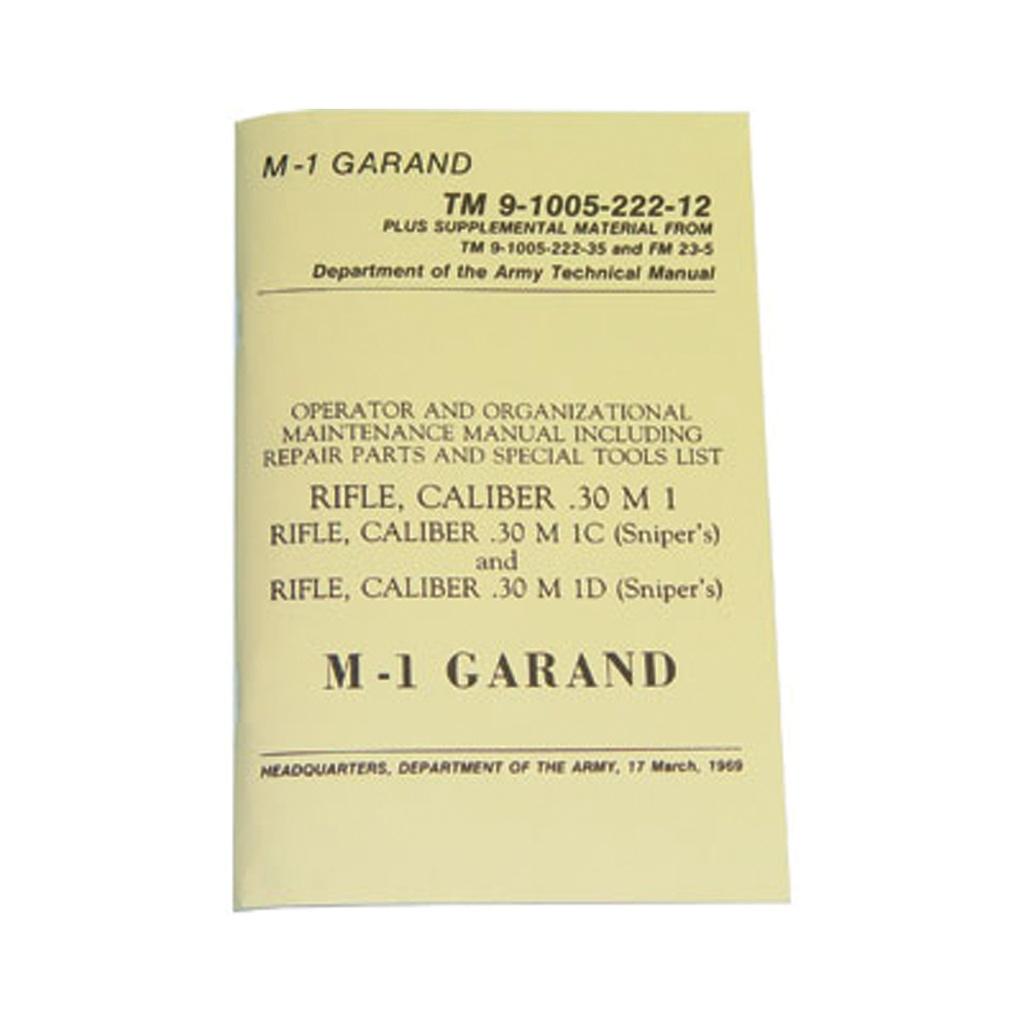
Late light on a Hill Country range bench, an old Garand cooling in front of you, this armorer technical manual open to the right page. It walks you through operator checks, organizational maintenance, parts, and tools for M1, M1C, and M1D rifles in clean Army language. No myth, no forum guessing—just the procedures that keep surplus steel running straight for Texas match days and pasture plinking alike.
When a Garand Lands on a Texas Bench
The first time an M1 Garand hits your bench in San Antonio, Lubbock, or a little town nobody writes songs about, you learn something fast: stories don’t keep rifles running. Procedures do. This ordnance-yellow armorer technical manual sits where it should—open by the vise, oil bottle nearby, a .30-06 case rolling slow across the mat while you read the next step.
It’s laid out in the Army’s own no-nonsense format. Operator checks. Organizational maintenance. Repair parts and special tools. It covers the M1 service rifle and the M1C and M1D sniper variants the same way a good Texas range officer calls the line—clear, direct, and with nothing extra.
Texas OTF Knife Buyers and the Same No-Nonsense Mindset
Folks who search for an OTF knife in Texas tend to like tools that either work or get tossed. This armorer manual fits that same mindset. Where a Texas OTF knife lives in your pocket for daily carry, this lives by the cleaning mat for every Garand you own, trade into, or tune up before deer season or a vintage match in Midland.
Instead of forum arguments and half-remembered gun show talk, you get Army diagrams and checklists. Step-by-step teardown. Proper lubrication points. Correction of common faults. The kind of information a Texas buyer expects when they look for real guidance—straight, technical, and proven in service, not cooked up for marketing.
How This Armorer Manual Works on a Texas Range
Picture a Saturday at a Panhandle range. Steady wind, mirage lifting off the berm, a line of old warhorses on the racks. Between strings, you’re under the shade cover with this manual cracked open. The softcover lies flat enough you can keep one hand on the rifle and one on the page, walking through an organizational check the way the Army laid it out in 1969.
It spells out operator-level care first, so a new Garand owner in Houston can learn the basics without fear of overdoing it. Then it reaches deeper into armorer-level tasks pulled from supplemental manuals TM 9-1005-222-35 and FM 23-5, giving the kind of detail a small-town Texas gunsmith uses when a customer brings in a CMP rifle that “just doesn’t group like it should.”
Exploded views and part ID help you match the piece in your hand to the line in the book. That matters when you’re ordering springs and pins to your ranch in the Hill Country or a small shop outside Corpus, where returns take time and freight isn’t cheap. You read, you verify, you order once.
Texas Context: Where This Manual Earns Its Keep
Across the state, Garands show up in the same places Texans carry their OTF knives—truck consoles, ranch houses, backroom safes at small-town hardware stores. A Texas OTF knife rides with you every day, but the M1 gets its time when the weather breaks, the range opens, or hogs start showing up under the feeder again.
Before that rifle leaves the safe for a hunt in the South Texas brush or a Memorial Day match near Dallas, you can run through the operator and organizational checks laid out here. Gas system. Sights. Trigger group. Stock fit. You don’t guess. You follow the same checklist an Army armorer would have used when these rifles were on issue.
For a collector, this manual is proof on paper. It lets you confirm whether a rifle has been tinkered with beyond spec. For a shooter, it’s the difference between a rifle that just “goes bang” and one that runs clean through a Garand match at a Central Texas club without a hiccup.
Legal Reality, Texas Rifles, and Why Paper Still Matters
In Texas, the law has grown friendlier to tools over the years. Where folks once worried over switchblades and the legal status of an OTF knife in Texas, today’s concern is more about responsible use and safe handling than blade mechanisms. The same attitude carries over to rifles like the M1 Garand: know the rules, know your gear, and keep it in safe operating shape.
Texas Responsibility at the Bench
On a workbench in Amarillo or a garage in Katy, this technical manual is part of that responsibility. It keeps guesswork out of headspace checks, sight adjustment, and parts replacement. It spells out what’s operator-level and what should be left to a more advanced armorer or gunsmith, so a new Texas owner doesn’t get in over their head.
From Surplus Rack to Safe Texas Shooter
Plenty of Garands change hands at Texas gun shows. Some come off a table ready to run, others need attention. With this manual, you can sit down the next day, strip the rifle, and compare every step and part to the Army’s own expectations before you ever chamber a live round on a local range.
Questions Texas Buyers Ask About OTF Knife Texas and Rifle Manuals
Are OTF knives legal to carry in Texas?
Yes. Under current Texas law, automatic knives and OTF knives are legal to own and carry for most adults, as long as you’re not in a prohibited place and you’re otherwise allowed to possess a knife or firearm. The focus now is more on location and behavior than the specific opening mechanism. Texans who buy an OTF knife for daily carry usually pair it with clear, authoritative information for their firearms as well—which is where an official-style Garand technical manual fits in.
Does this M1 Garand manual cover real armorer procedures?
It does. This is a Department of the Army technical manual format, TM 9-1005-222-12, with supplemental material drawn from TM 9-1005-222-35 and FM 23-5. It walks through operator and organizational maintenance, troubleshooting, and parts, with diagrams and checklists written the way an armorer in a motor pool or depot would have used them. On a Texas bench, that means you’re working from the same instructions that kept service rifles running when they weren’t collectors’ items yet.
Is this worth it if I already watch videos?
If you’re in Houston or El Paso with fiber internet, videos are handy. But when you’re on a rural property, at a West Texas lease house, or in a concrete range bay with bad reception, a softcover manual that lays flat and doesn’t buffer is worth more than another tab open on your phone. It gives you the exact torque, order of operations, and part identification in print, so you’re not pausing, rewinding, and hoping the creator got it right. For most Texas Garand owners, videos are where you start; this is what you trust when it’s time to actually turn screws.
Putting It to Work in a Texas Moment
End of a long day. Targets pulled, brass in the bucket, wind easing off the mesquite. You’ve got an M1 on the mat and this ordnance-yellow book open, thumbing through one last checklist before the rifle goes back into the case. The pages are starting to curl at the corners, oil-stained in spots, which is how you know it’s doing its job.
Whether your daily pocket ride is an OTF knife or a beat-up stockman, this is the same idea—carry what works, keep what you can trust, and learn it well enough to fix it yourself. For a Texas Garand owner, that starts with the right manual on the bench.