Brushline Sawback Survival Knife - Wood Handle
6 sold in last 24 hours
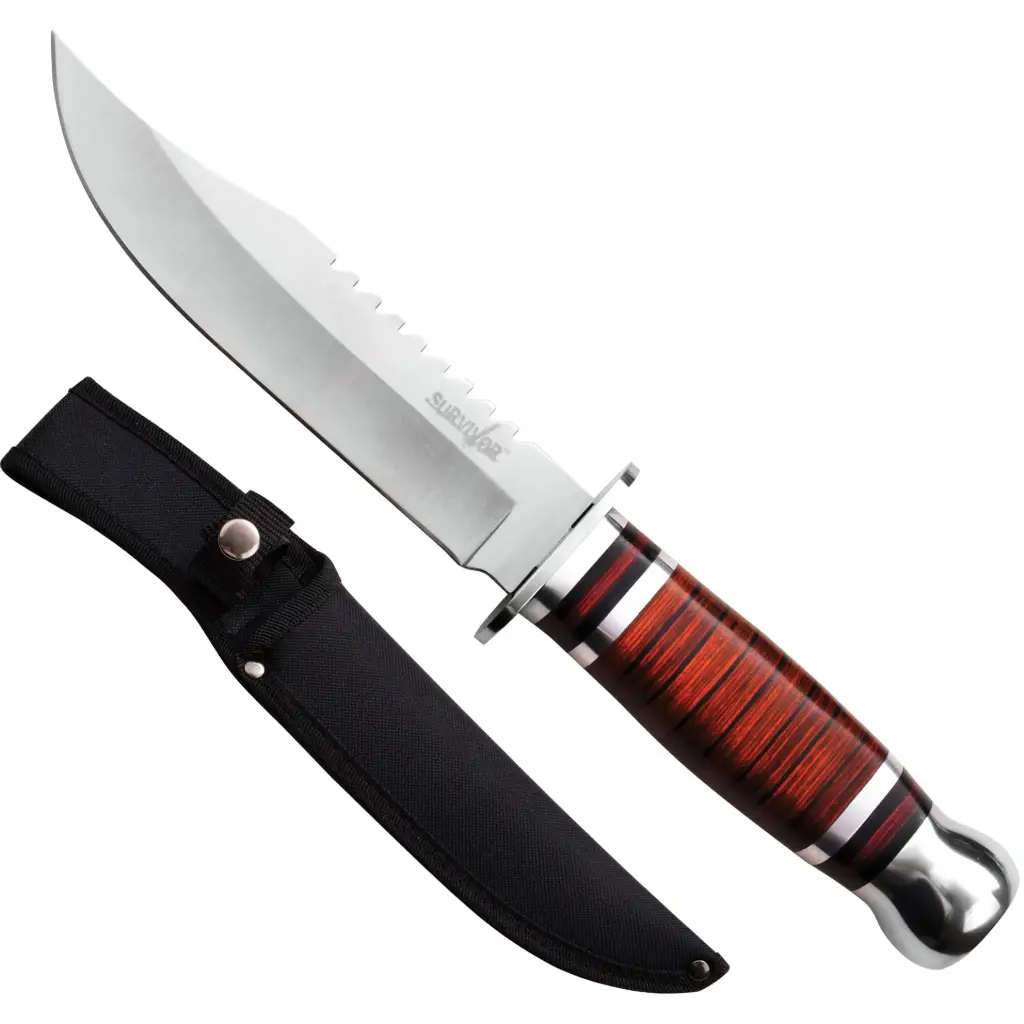
First light over scrub and mesquite, gate chained tight, and one survival knife riding your belt like it’s been there for years. A 6-inch satin clip-point blade with sawback spine and partial serrations bites through rope, sapling, and camp chores. Full-tang stainless steel, a warm wood handle, and a nylon sheath that doesn’t complain in dust or sweat. For Texans who’d rather carry one honest field knife than three fancy toys.
Brushline Work That Calls for a Fixed Blade Survival Knife
Dry grass up to your knees, a loose stretch of fence somewhere past the last tank, and just enough daylight left to fix what the wind tore down. That’s when a simple survival knife on your belt matters more than whatever stayed clean in the toolbox. A 10.5-inch fixed blade with a 6-inch working edge, sawback spine, and partial serrations is built for those last miles on foot when the truck can’t get you there.
This isn’t a glass-case collectible. It’s a field-ready survival knife with a satin clip-point blade, full tang, and a rounded pommel that does real work in the brush. The warm, glossed wood handle fills the hand when sweat, dust, and fatigue make every cut slower except the one that matters.
How This Fixed Blade Knife Earns Its Place in Texas Country
Across Hill Country cedar breaks, Panhandle windrows, or live oak thickets along the river, the jobs don’t change much: cut, pry, notch, clear, and move on. A clip-point survival knife with a sawback spine lets you do that without babying the edge. Stainless steel with a spine thickness a touch under 0.14 inches gives enough bite for notching posts, scraping bark, or shaving tinder without feeling like a pry bar on your belt.
The partial serrations near the handle end turn stubborn nylon rope, feed bags, and old lariat into one pull instead of three. When you’re cutting baling twine out of a wind-snagged fence or dropping dead limbs over a trail, the sawback rides the top of the blade, ready to chew through light wood where a smooth edge just skates. One survival knife, three honest cutting surfaces, and no moving parts to fail.
Field-Ready Survival Balance: Blade, Handle, and Sheath
A survival knife that sees real pasture time has to sit right in the hand and on the belt. At 10.5 inches overall, this fixed blade keeps enough reach for heavy push cuts and light chopping, while the 4.5-inch wood handle anchors your grip. The full tang runs the length of the handle, guarded by a straight crossguard that keeps your hand from riding up when you’re driving the point into tough material.
The rounded metal pommel caps the tang, giving you a solid heel for tapping tent stakes, cracking ice on a stock tank edge, or nudging stubborn hinges without hauling a hammer. That same pommel shapes the balance point forward enough to make the 6-inch blade feel like a tool, not a toy, when you’re breaking limbs for a cooking fire or trimming back green growth along a deer trail.
Riding on the hip, the black nylon sheath stays quiet and light. It hangs from a belt without dragging your waistband down, and the snap closure keeps the blade seated when you’re stepping over barbed wire or ducking under low limbs. Dust, sweat, and a truck cab that bakes in August don’t bother nylon. You draw, work, and re-sheath without thinking about it.
Texas Knife Law, Fixed Blades, and Carrying a Survival Knife
There was a time when Texans had to think hard about blade length and what counted as a "location-restricted" knife. That changed when the state relaxed its rules, cleared language around long blades, and took the heat off folks carrying practical tools. Today, a fixed blade survival knife like this is legal for adults to own and carry in most day-to-day Texas life, with a few common-sense limits.
Where a Survival Knife Fits Under Texas Law
State law draws lines around sensitive places: schools, polling locations, court facilities, and certain government buildings. Those zones remain tight on long blades. But out on private land, leases, ranch roads, public hunting areas, campgrounds, and around the house, a belt-carried fixed blade survival knife is understood for what it is: a tool. Texans who keep a field knife in the truck or on the hip usually aren’t looking for trouble—just trying to get work done when the pliers and fencing tools don’t quite reach.
Why Some Texans Still Prefer a Fixed Blade
Even with automatic and assisted knives allowed, a lot of Texans stick with a straightforward survival knife. No springs. No button. Just a full-tang blade, a solid handle, and a sheath. On a lease in South Texas, in the pines east of Lufkin, or working wind-swept fence in the Panhandle, fewer moving parts mean fewer chances for dust, grit, and sweat to shut your gear down. This knife fits that mindset: simple, reliable, easy to clean with a rag and a little oil at the end of the week.
Survival Knife Uses from Deer Camp to Dry Creek Beds
At a low-water crossing after a flash flood, you may be clearing washed-in limbs from under a trailer, shaving kindling from damp branches, or cutting a length of rope to secure a load. The stainless clip-point blade handles fine tip work when you’re opening feed sacks or trimming cord, while the broader belly takes on camp chores from food prep to baton-style splits through small chunks of wood.
In Camp, On Lease, and Around the House
Morning at deer camp, this survival knife comes out to slice bacon, trim back branches in a shooting lane, and scrape a stubborn sticker off the side of an old cooler. Back in town, it waits in the truck console or on a peg in the mudroom, ready to cut landscape fabric, notch a garden stake, or whittle down a shim for a sagging gate. Same tool, same edge, different day.
The glossed wood handle isn’t there for show. It gives a warm, secure grip on cold mornings and hot afternoons alike. The subtle contour lets you choke up for detail work or drop back toward the pommel for more leverage when sawing through thicker branches with the spine teeth. Gloves on or bare-handed, the handle lets you know where that full tang sits in your palm.
Questions Texas Buyers Ask About a Fixed Blade Survival Knife
Are OTF knives legal to carry in Texas?
Yes. Texas removed the old switchblade restrictions, so OTF knives and other automatics are legal for adults to own and carry in most everyday settings. The same general rules apply as with longer fixed blades: avoid schools, certain government buildings, and other location-restricted areas. For ranch work, camping, hunting, and general daily life, Texans are free to choose between an OTF and a fixed blade survival knife like this one, depending on what suits their hand and habits.
Is this survival knife a good fit for Texas ranch and lease work?
If your days involve cutting feed bags, trimming small limbs, freeing tangled wire, or setting up and breaking down camp, this full-tang survival knife fits. The 6-inch stainless blade with sawback spine and partial serrations handles rope, small saplings, and general utility work without babying the edge. The nylon sheath rides well on a belt through tall grass, loose sand, or muddy pasture without demanding attention.
Should I choose this fixed blade over an OTF or folding knife?
If you want one tool that can baton light wood, take hard lateral pressure, and shrug off grit and mud, a fixed blade survival knife earns its keep. An OTF or folder rides smaller in the pocket and opens faster one-handed, but they’re not built for the same abuse. Many Texans carry a pocket folder or OTF for light daily cuts and keep a belt-carried survival knife like this for the heavier jobs that show up when you step past the end of the pavement.
First Use: A Quiet Evening, One Honest Survival Knife
Dusk settles over the pasture, cicadas working the fence line, last heat bleeding out of the ground. You drop from the truck, survival knife on your belt, and walk the short stretch to a gate you’ve been meaning to fix. The blade clips through old rope, the serrations bite clean, and the sawback helps trim a low limb that’s been scraping the top of the stock trailer.
By the time the light is gone, the knife is back in its nylon sheath, edge wiped on your jeans, handle warm from use. It doesn’t need polishing or praise. It just hangs there on your belt, ready for the next early morning, the next dry creek crossing, the next piece of Texas ground that doesn’t care what you paid for a tool—only whether it works.
| Blade Length (inches) | 6 |
| Overall Length (inches) | 10.5 |
| Blade Color | Silver |
| Blade Finish | Satin |
| Blade Style | Clip Point |
| Blade Edge | Partial-Serrated |
| Blade Material | Stainless Steel |
| Handle Finish | Gloss |
| Handle Material | Wood |
| Theme | None |
| Handle Length (inches) | 4.5 |
| Tang Type | Full Tang |
| Spine Thickness (inches) | 0.1375 |
| Pommel/Butt Cap | Rounded Pommel |
| Carry Method | Belt Carry |
| Sheath/Holster | Nylon Sheath |