
Field Bench Discipline Armorer Manual - Camo Cover
5 sold in last 24 hours
Out past Abilene or down in Atascosa, an AR that won’t run is more than an inconvenience. This Marine-modeled AR-15 owner’s manual walks you through real armorer work: breakdown, cleaning, inspection, parts swaps, and reassembly, with M16 crossover details spelled out clean. Clear diagrams, torque limits, and tools lists read like a seasoned rifle tech talking over your bench. For Texas shooters who’d rather fix their rifle right than guess twice.
When Your AR Has to Run From Pecos to Port Arthur
Dust that crawls into every spring out near Pecos. Salt air working on steel along the Upper Coast. Range days in San Antonio that roll from drizzle to glare in one afternoon. In this state, an AR-15 that only runs on clean indoor benches isn’t worth much. That’s where a real armorer-grade manual earns its place.
The Field Bench Discipline Armorer Manual - Camo Cover reads like a Marine armorer dropped his notes on your workbench and left you the keys. It’s built for the owner who actually runs an AR in Texas conditions, then expects it to light back up every time.
Texas AR-15 Confidence Starts at the Bench, Not the Counter
Most rifle booklets tell you where the safety is and call it a day. This one was modeled after Marine M16 procedures, then brought over clean to the AR-15 platform. It walks you, step by step, through field strip and full tear-down, with each part named, checked, and put back in the right place.
Picture a Saturday in a Hill Country garage. Barrel still warm from a morning on a private range outside Boerne. You clear the rifle, lay this camo-covered manual flat, and follow its sequence: upper and lower separated, bolt carrier group stripped, gas rings checked, extractor inspected. The pages don’t assume you already know—yet they never talk down. It’s written like a professional who’s been building and fixing service rifles for decades, explaining it once so you don’t have to ask twice.
How This Manual Fits Texas AR-15 Culture
In this state, an AR-15 works as ranch tool, home-defense rifle, match gun, and truck companion. That mix means more rounds, more dust, more sweat, and more chances for small mistakes to turn into big malfunctions. This manual leans into that reality.
Mounted optics for hogs in the Panhandle? There’s guidance that keeps you from over-torquing mounts and stripping threads. Running high round counts at a carbine class outside Houston? The maintenance sections help you schedule real cleaning instead of wiping it down and hoping for the best. If you hand your rifle to a son or daughter at a lease outside Laredo, you’ll know what went into it: bolts checked, gas key tight, castle nut staked, everything verified against Marine-style inspection standards.
Texas OTF Knife Buyers Still Need a Rifle Manual
The same buyer who searches for an OTF knife Texas carry piece is usually the one who keeps an AR-15 close at hand. A dependable OTF rides in the pocket; a dependable rifle sits behind the truck seat or by the safe. Both need more than guesswork. This Marine-style AR-15 owner’s manual sits right beside that Texas OTF knife in your kit, covering the rifle side of your preparedness.
If your everyday carry includes a trusted Texas OTF knife and a well-used AR, this book bridges the gap between edge maintenance and rifle care. It’s the printed counterpart to the respect you already show your blades—dry, exact, and focused on function.
What’s Inside: Real Armorer Work, Not Gun-Show Talk
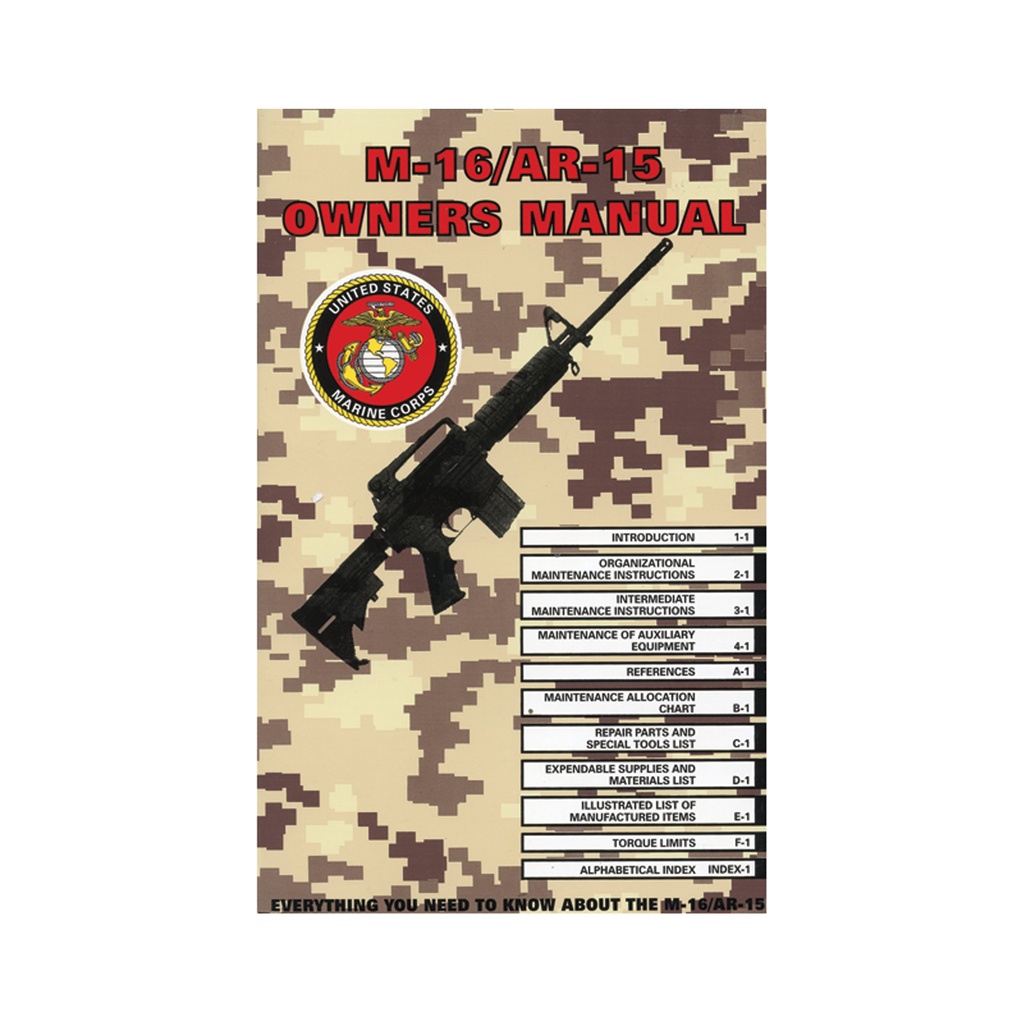
Open the camo cover and you’ll see it’s laid out like a professional manual, not a glossy catalog. Sections break down introduction, references, maintenance, torque limits, and full parts lists. For a Texas shooter, that structure matters when you’re tired, dirty, and trying to fix something right the first time.
The maintenance instructions don’t stop at "wipe the carbon." They cover where to look for hairline cracks, how to recognize abnormal wear on lugs, what loose staking looks like on a carrier key, and when a spring is tired enough to retire. Torque tables keep you from shearing fasteners on rail systems and accessories. Tool lists mean you walk into a Houston shop or Amarillo hardware store knowing exactly which punches, wrenches, and gauges you need to do the job once.
Because it also speaks to the M16 platform, a Texas buyer who’s shot issued rifles—or keeps a retro build in the safe—gets clear crossover notes. It ties together the service rifles you might have carried in uniform and the AR-15 you run now on Texas soil.
Texas Rifle Reality: Law, Readiness, and Responsibility
Why Legal Texas Owners Still Need Technical Discipline
In Texas, owning and running an AR-15 is straight, legal business for law-abiding adults. The law isn’t what usually fails you—neglect is. This manual speaks to the quiet responsibility side of gun culture across the state. Whether you’re outside Midland on a lease, in a Dallas suburb, or on a place outside Nacogdoches, a rifle that won’t feed when you need it is on you, not the legislature.
This book helps you carry that weight the right way. It’s not about pushing boundaries. It’s about knowing your rifle is mechanically sound, safe, and ready, because every critical point was inspected against professional standards, not forum chatter.
From Armory Racks to Texas Gun Rooms
The Marine emblem on the cover isn’t for decoration. It signals a way of working: checklists, reference tables, and procedures that assume the rifle is more than a toy. That mindset translates cleanly to Texas gun rooms, shop benches in San Angelo, and training classes outside Austin.
Range owners can keep a copy on hand to walk new AR owners through routine checks. Instructors can reference specific sections when teaching teardown in a classroom, letting students see each step instead of relying on memory. Retailers can pair it with rifles at sale, sending buyers out the door with more than a box and a handshake.
Questions Texas Buyers Ask About AR-15 Owner’s Manuals
Are OTF knives legal to carry in Texas?
Yes. Under current Texas law, switchblades and OTF knives are legal to own and carry for law-abiding adults, with location-based exceptions that apply to all "location-restricted" knives—places like schools, certain government buildings, and secure areas. Most everyday carry across the state is legal, but it’s wise to review the latest Texas statutes or talk to a knowledgeable local dealer before you push the limits. The same mindset that leads you to a serious AR-15 owner’s manual should guide how you carry any blade.
Will this manual help a first-time Texas AR-15 owner?
It will. The language assumes you can follow directions and respect safety, not that you already know the names of every pin and spring. If you just bought your first AR in Fort Worth or College Station, you can lay the rifle on the table, open this manual, and work step by step without guessing. Diagrams and clearly labeled sections keep you from getting lost halfway through a teardown.
Why choose this manual over free online videos?
Because when you’re sitting at a bench in a hot barn outside Kerrville, signal comes and goes, but paper doesn’t buffer. This manual doesn’t skip steps, doesn’t chase sponsors, and doesn’t disappear when a channel gets pulled. It gives you vetted, repeatable procedures you can follow every time. Mark pages, add notes, hand it to a buddy—no passwords, no updates, no distractions.
From Panhandle Dust to Gulf Humidity: Your Rifle, Verified
Picture this: late evening, south of San Angelo. The wind’s dropped. You’ve put the last magazine through your AR at a caliche pit you’ve shot for years. Back home, the rifle comes out on the kitchen table or a shop bench. This camo-covered manual opens, and you move through the routine—bolt stripped, gas system checked, receiver cleaned, parts inspected against standards written by people who carried rifles for a living.
By the time you close the book, the rifle is more than oiled. It’s known. The same way you keep your Texas OTF knife sharp and trustworthy, this manual keeps your AR-15 honest. Next time you step out—whether it’s a hog run under red light, a match near Dallas, or a simple range day in Waco—you’re not hoping it runs. You’ve already done the work to make sure it will.