
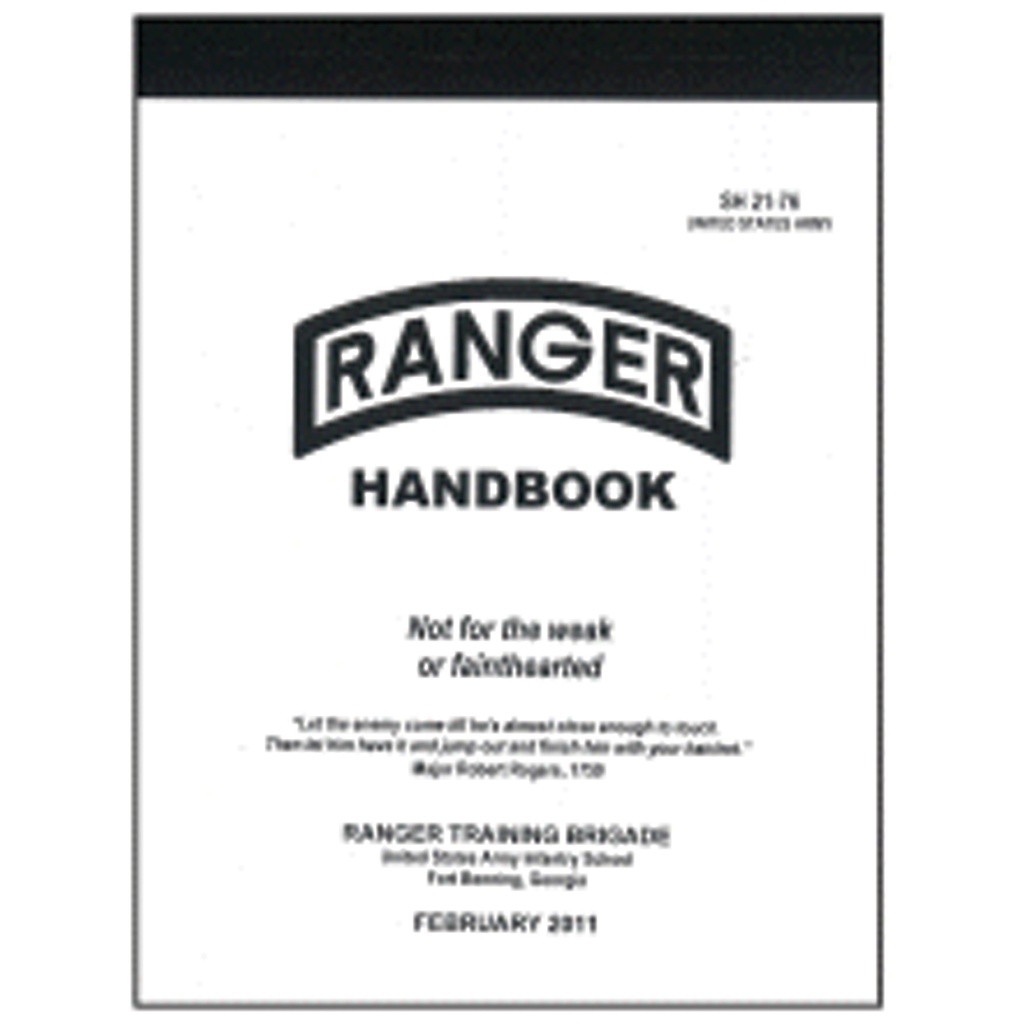
Not For The Weak Ranger Field Manual - Black Cover
10 sold in last 24 hours
South of San Angelo or outside Killeen, this pocket Ranger field manual rides next to your OTF in the same cargo pocket. Black cover, February 2011 text, all business. Leadership under pressure, small‑unit moves, fieldcraft that still works when the radios don’t. It’s the doctrine side of your Texas kit—quiet, blunt, and not for the weak or fainthearted.
Field Truth in a Cargo Pocket
Out past the last streetlight outside Copperas Cove, the real decisions don’t happen on a screen. They happen in the dark, under a red lens, with dirt in your teeth and a plan that has to work. That’s where this pocket 2011 Ranger Handbook belongs—riding behind your everyday Texas OTF knife in the same cargo pocket, creased, dog-eared, and trusted.
This isn’t a coffee-table reprint. The black-and-white cover carries the Ranger Training Brigade imprint and the February 2011 date that still shows up in team rooms. Inside is doctrine written for people who actually step off. Leadership when the squad is smoked. Movement when the map is half-wet. Checklists that don’t care if you’re in the pines at Camp Swift, the draws west of San Antonio, or the brush outside Brownsville.
Why This Pocket Ranger Handbook Belongs Beside a Texas OTF Knife
A Texas OTF knife is the tool you flick open when the strap needs cutting or the line’s in the way. This Ranger field manual is the one you open when the decision carries weight. Same pocket, different jobs. One is steel. One is paper and ink. Both earn their place.
The pocket format matters. It disappears into ACU or OCP cargo pockets, slides into a plate carrier admin pouch, or tucks into the door pocket of a ranch truck that spends more time on caliche roads than pavement. The black cover shrugs off sweat, dust, and spilled coffee. The monochrome pages are meant to be written on, underlined, and tabbed with whatever tape you’ve got.
For Texas buyers building out a kit—whether it’s for duty around Fort Cavazos, ROTC training in College Station, or long weekends on private land—this handbook sits right next to the OTF knife Texas carriers already trust. Steel handles the immediate problem. Doctrine shapes what happens next.
Doctrine Written for Real Ground, Not Theory
Open the cover and you’re into the same structure Rangers have worked from for years. Leadership principles that don’t soften hard truths. Planning steps that force you to think beyond the first contact. Simple, direct language—no fluff, no filler. It reads a lot like the way a seasoned Texas NCO talks to a young soldier behind the motor pool.
Out on a wind-scoured live-fire lane at North Fort Hood or a rough private range outside Abilene, this isn’t just reading material. It’s a pressure check. Are you thinking through security? Have you actually rehearsed? Is your team squared away or just getting by? The pages push those questions every time you flip them.
The size invites use. It sits flat on a Humvee hood while you sketch a quick plan. It balances on a tailgate under a dim bed light while you walk a buddy through a rehearsal. You can brace it against your knee in the back of a rattling up-armored truck, highlighter bouncing while the driver dodges potholes.
Texas Knife Culture, Texas Training Mindset
Across the state, from drill weekends in Grand Prairie to night quals outside El Paso, there’s a certain kind of buyer who pairs hard-use gear with hard-won knowledge. The same person who keeps a Texas OTF knife clipped in their pocket keeps this handbook where they can reach it—with the same expectation: when it’s needed, it will deliver.
Texas knife laws now recognize OTF knives and other automatics as tools, not contraband. That shift mirrors the way serious Texas buyers treat manuals like this. Not decor. Not props. Tools. The OTF handles the rope, webbing, and day-to-day cutting that comes with ranch work, duty shifts, or long miles. The Ranger Handbook handles the planning, discipline, and leadership that keeps people alive when things go sideways.
In a Hill Country hunting camp, it might be the quiet book someone thumbs through by lantern after the fire dies. In a barracks room at Fort Cavazos, it’s the beat-up copy that gets passed around before a selection packet goes in. On a small property along the Red River, it’s the reference for the landowner who insists on running their security plans like a squad, not a hobby.
Texas Law, Real-World Use, and Where This Handbook Fits
Texas has taken most of the mystery out of knife and OTF carry. Automatics, including OTF designs, are legal under state law for everyday use, with a few location restrictions Texans already know by heart—schools, certain government buildings, places posted against weapons. That clarity lets serious buyers focus on what matters: carrying tools they’ll actually use, and learning how to think under pressure.
This 2011 pocket Ranger Handbook doesn’t deal in state statutes. It deals in something older—how small teams move, decide, and survive. For Texas law, you’ll check the penal code or talk to someone who keeps up with it. For how to build a quick plan in the dark, this is what you reach for.
How Texas Carriers Pair OTF Knives and Doctrine
Along the border, in the oil patch, on game ranches, and on city SWAT teams, you’ll see the same pattern: a reliable automatic or OTF knife Texas law allows, a light that always works, and one quiet paper reference that doesn’t need a battery. This handbook fills that last slot. It lives in glove boxes beside trauma kits. It rides in rucks with extra mags and a rain jacket. It’s there when the phone dies and the job isn’t done.
From Fort Cavazos to Far West Pastures
For the soldier rotating through a field problem in the scrub north of Killeen, the ROTC cadet sweating through a summer FTX near San Marcos, or the ranch hand running night checks for hog sign on the edge of the Big Bend country, the rhythm is the same. Gear gets checked. Knife. Light. Water. Map. Handbook. Then the work starts.
Questions Texas Buyers Ask About a Pocket Ranger Handbook
Are OTF knives legal to carry in Texas?
Yes. Under current Texas law, automatic knives, including OTF designs, are legal to own and carry for adults in most everyday situations. The state removed the old switchblade ban, and now treats these knives like other blades, with restrictions tied more to blade length and specific sensitive locations than to the opening mechanism. You still have to respect posted premises, schools, certain government buildings, and any federal property rules, but a well-chosen OTF knife Texas buyers carry is lawful across most of the state. Always confirm current statutes if you work in regulated environments—law enforcement, corrections, or certain industrial sites.
Is this 2011 pocket Ranger Handbook useful outside the military?
For a lot of Texans, yes. The language is military, but the core is planning and leadership under stress. A ranch foreman west of Wichita Falls can use the same principles to run his crew that a squad leader uses on a live-fire lane. Volunteer search-and-rescue teams in the Hill Country lean on the same checklist thinking. Even a firearms instructor running a one-day class outside Houston can pull structure from these pages—brief, rehearse, execute, debrief.
Should I carry this handbook and my Texas OTF knife every day?
Some do. Some don’t. If your days bounce between uniformed duty, range work, rural property, or deployments, having doctrine within arm’s reach makes sense. The pocket size means it’s not in the way. You’ll carve your own answer over time. Most Texans who keep it close find that it gets marked up, folded over, and eventually replaced—with another one just like it.
Built for the First Quiet Minute Before Things Get Loud
Picture a cold front pushing through central Texas, sky low and grey over the training area. You’re leaning against a tailgate outside a chalked Humvee, OTF clipped in your pocket, this black-covered Ranger Handbook open in your hands. You walk the plan one more time. Routes. Signals. Contingencies. Then you close the book, slide it back into your cargo pocket, and tap the knife once by habit.
Steel for when the moment snaps. Doctrine for everything leading up to it. For Texans who live somewhere between pasture, range, and rally point, that combination feels about right.